


The Montessori Curriculum
How we use it every day at Creative Minds — and the remarkable 118-year story of where it came from, how it conquered doubt on two continents, and why a certified Montessori guide is unlike any other preschool teacher.
Updated · August 20, 2026
Montessori at Creative Minds
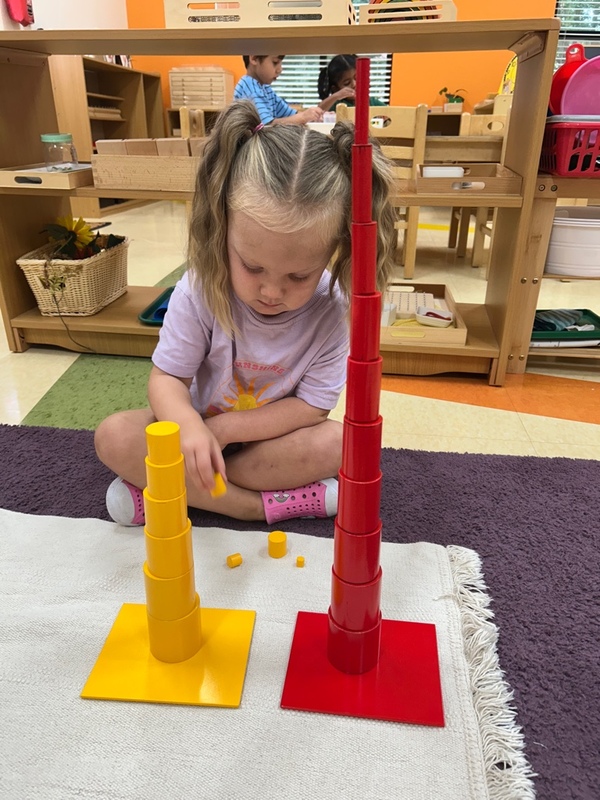
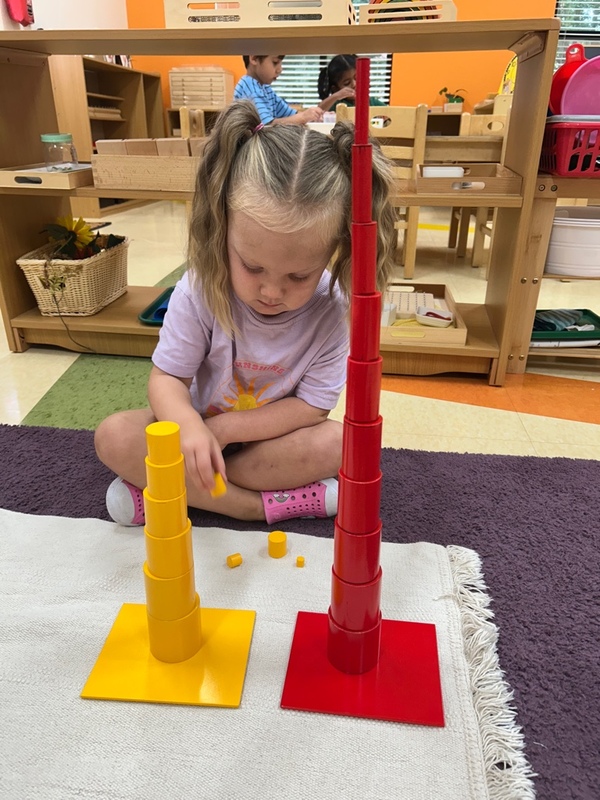
Walk into one of our classrooms mid-morning and the first thing you’ll notice is the quiet hum of concentration. One child is building the pink tower, testing with her hands how ten cubes relate in size. Another is spooning beans between bowls — practicing, without knowing it, the pencil grip he’ll use to write. A teacher kneels beside a third child, giving a short, precise lesson, then steps back and lets the work happen.
That is the Montessori curriculum in action. It isn’t a workbook or a weekly theme packet — it’s a prepared environment stocked with scientifically designed materials, a trained guide who observes each child and presents the right lesson at the right moment, and long, uninterrupted work periods in which children choose meaningful work and carry it through.
At Creative Minds the curriculum spans five interwoven areas — practical life (pouring, buttoning, food preparation, care of the classroom), sensorial (materials that isolate size, shape, color, sound, and texture), language (sandpaper letters, the movable alphabet, early phonics), mathematics (golden beads, number rods, the concrete path to abstraction), and cultural studies (geography, zoology, art, and our beloved weekly music class). Our Nido, Pre Casa, and Casa programs carry a child from 6 weeks through Kindergarten readiness on this one continuous arc.
Twenty Ways the World Teaches Its Youngest
Montessori is one of twenty great answers the world has given to the question of how young children learn. Our guide, Early Childhood Education Methodologies, tours all twenty — from Fröbel’s first kindergarten and Reggio Emilia’s ateliers to forest schools, Anji Play, and traditions as old as ancient Athens and Vedic India. Each entry tells you where the method came from, who shaped it, and what it believes about children — with a full research paper behind every one. It’s the map that shows exactly where Montessori, and our artistic Waldorf blend, sit in the wider landscape.
We didn’t study the other nineteen to hedge our bets — we studied them to sharpen our own. Seeing how Reggio Emilia trusts children as researchers, how Waldorf guards imagination and the arts, and how Fröbel first understood play as serious work only deepens our conviction about the Montessori foundation our classrooms rest on — and it’s why our Casa mornings weave in an artistic, Waldorf-inspired thread and a beloved weekly music class. A method you can hold up against every serious alternative is a method you can trust.
Explore all twenty — two ways:
Who Chooses Montessori — and Why
Montessori’s modern following is strikingly consistent. Highly educated professional parents — engineers, physicians, academics, and especially technology families — are overrepresented, drawn by the method’s respect for independent problem-solving (the “Montessori Mafia” of tech founders is a running joke in Silicon Valley). Immigrant families, notably South Asian and East Asian parents here in the Dallas–Frisco corridor, often choose Montessori because it uniquely offers both things they want: genuine early academics — real letters, real numbers, real work — without the worksheet drill and pressure they hoped to leave behind.
Across demographics, the reasons parents give converge on the same few themes: children who can do things for themselves; calm, orderly classrooms instead of chaos; a child who asks to go to school; and early academic depth that arrives through the hands rather than through flashcards.

Come Watch It Work
Essays are one thing; a quiet classroom full of three-year-olds absorbed in real work is another. Come see the curriculum with your own eyes — and once enrolled, keep watching through our live classroom cameras. Curious about the day-to-day details? Our FAQ and Parent Handbook cover everything from meals to nap time.

The Doctor Who Watched Children
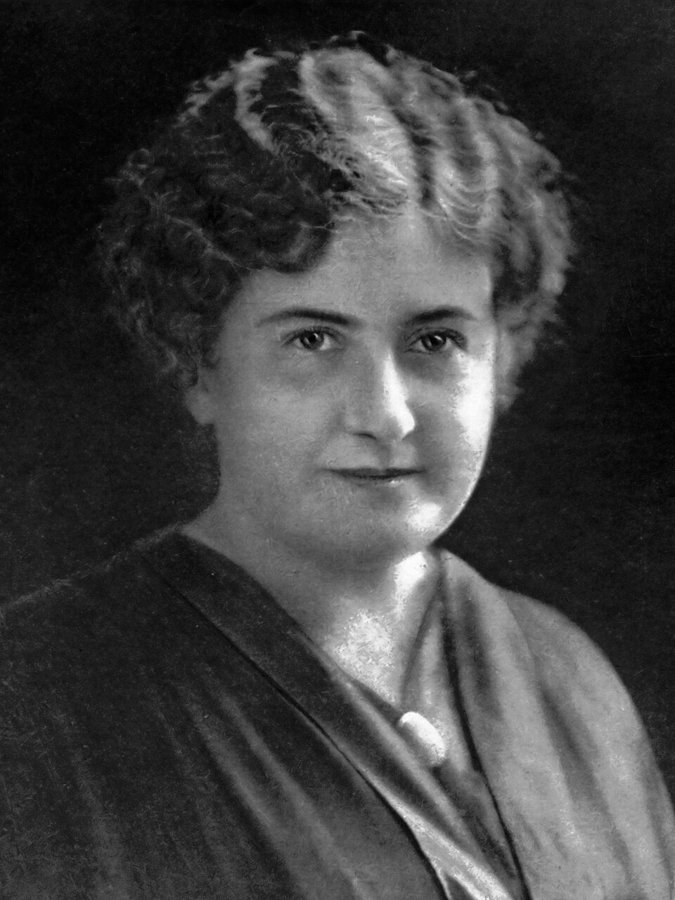
The method begins not with a teacher, but with a scientist. Maria Montessori (1870–1952) — one of Italy’s first female physicians — drew a radical conclusion from her early clinical work with children in Rome: they were not failing education; education was failing them.
On January 6, 1907, she opened the Casa dei Bambini (the “Children’s House”) in one of Rome’s poorest districts. Given child-sized tools, freedom of movement, real responsibilities, and self-correcting materials, the children developed astonishing concentration, self-discipline, and joy in work — she had uncovered what children do when the environment finally fits them. Within two years she published her method; by 1909 she was training teachers worldwide, and the idea spread fast — across Europe, to India, and to America.
Portrait of Dr. Montessori: public domain, via Wikimedia Commons.
The Method Meets Its Skeptics
Montessori arrived in the United States on a wave of magazine ink. In 1911 the first American Montessori school opened in Tarrytown, New York, and publisher S. S. McClure ran a series of breathless articles in McClure’s Magazine that made “the Montessori method” a household phrase. The movement’s American admirers were not fringe figures:
- Alexander Graham Bell and his wife Mabel helped found the Montessori Educational Association in 1913, with President Wilson’s daughter Margaret among its supporters.
- Montessori herself toured the U.S. in December 1913, lecturing to an overflowing Carnegie Hall.
- At the 1915 Panama–Pacific Exposition in San Francisco, a working Montessori classroom was set up behind glass — and spectators watched, amazed, as thirty children worked in serene concentration. By the mid-1910s some one hundred Montessori schools had opened across the country.
Then, almost as quickly, it collapsed. In 1914 William Heard Kilpatrick — a hugely influential professor at Columbia’s Teachers College and a disciple of John Dewey — published The Montessori System Examined, dismissing the method as scientifically outdated. The progressive-education establishment followed his lead, Montessori’s insistence on controlling her own teacher training limited local champions, and the First World War cut the movement off from its founder. By the 1920s, Montessori had all but vanished from America.
The Standard That Survived
The method’s middle chapters read like a novel. Mussolini’s government initially embraced Montessori schools — until Montessori refused to let her classrooms be used to mold fascist youth. In 1934 she broke with the regime, and her schools were closed across Italy (Nazi Germany shuttered them too, and burned her books). She worked from Barcelona, then Amsterdam, and in 1939 traveled to India — where, as an Italian citizen when war broke out, she was confined as an enemy alien. Characteristically, she used the years of confinement to train over a thousand Indian teachers, planting what remains one of the world’s strongest Montessori cultures.
She was nominated for the Nobel Peace Prize three times in her final years, and died in the Netherlands in 1952. The organization she founded in 1929 to safeguard her work — the Association Montessori Internationale (AMI) — still trains teachers to her original standard today.
The Revival That Stuck
Montessori’s American resurrection was led by a young Catholic educator named Nancy McCormick Rambusch, who discovered the method in Europe and founded the Whitby School in Greenwich, Connecticut in 1958. In 1960 she founded the American Montessori Society (AMS), deliberately adapting the method to American culture — a split with AMI that, in hindsight, gave the movement two engines instead of one.
This time it took root. Today there are an estimated 5,000 Montessori schools in the United States — including roughly 600 public and charter programs — and Montessori is the largest alternative pedagogy in the world, practiced in well over a hundred countries. What began as a preschool movement has climbed the grades: public districts from Milwaukee to Dallas run Montessori elementary programs, hundreds of schools now extend through middle school, and a growing number of “Erdkinder” adolescent programs — some on working farms, as Montessori envisioned — carry the method into high school.
Its alumni list has become part of its legend: Google’s Larry Page and Sergey Brin, Jeff Bezos, Julia Child, and Nobel laureate Gabriel García Márquez all spent formative years in Montessori classrooms — and Page and Brin have credited that training for their independence of mind.
A Method That Learned to Adapt
Part of Montessori’s longevity is that it has adapted without dissolving:
- Science caught up with it. A landmark 2006 study in the journal Science, following children randomly assigned by lottery to Milwaukee’s public Montessori schools, found stronger academic and social outcomes; a 2017 longitudinal study in Hartford found Montessori preschoolers outpacing peers in literacy and executive function. Modern cognitive science — on movement and learning, executive function, and intrinsic motivation — keeps landing on conclusions Montessori reached by observation a century earlier.
- It made peace with standards. American Montessori schools long ago learned to map their curriculum to state kindergarten-readiness expectations — at Creative Minds, our program correlates to developmental milestones, Texas standards, and Kindergarten readiness skills while keeping the child-led core intact.
- It kept its head about technology. Consistent with both Montessori principle and Texas licensing, screens play essentially no role in the early-childhood classroom — a stance that once looked quaint and now looks prophetic.
- It scaled carefully. Public conversions, charter networks, and hybrid programs have broadened access far beyond the private-school niche of the 1960s revival.
The Modern Landscape: Montessori and Its Rivals
Parents comparing preschools today will meet several philosophies, each with real strengths — and real differences:
- Reggio Emilia — project-based and beautiful, driven by children’s collective interests; less structured in materials and with no formal teacher-certification standard.
- Waldorf (Steiner) — rich in imagination, rhythm, and art; academics are deliberately delayed, which suits some families and frustrates others.
- HighScope — a research-based “plan-do-review” model common in Head Start settings, strong on routine, lighter on individualized academics.
- National chain curricula — the proprietary programs of large franchises (Balanced Learning®, and similar branded systems) package themed units and rotating activities so that any hire can deliver them. That is precisely their limitation: the curriculum is designed to survive an untrained teacher.
Montessori’s distinction in this landscape is structural: it is the only one of these that combines a complete, sequenced set of materials from infancy to adolescence with a rigorous, independently accredited teacher-certification pipeline — and a century of continuous refinement behind both.
Curious where all these ideas came from? Every philosophy above has a story — and a research record. We’ve traced twenty early-childhood methodologies from ancient Athens to modern China in a parent-friendly guide, and examined each one against the peer-reviewed evidence in our Research Series — twenty full scholarly reviews with every source verified and linked.
The Credential Behind the Guide
“Montessori” was never trademarked — any school can put the word on its sign. What separates authentic programs is the training. Three institutions anchor it:
- AMI (Association Montessori Internationale, founded by Dr. Montessori herself in 1929) — the international standard-bearer, known for exacting fidelity to the original method.
- AMS (American Montessori Society, 1960) — the largest U.S. organization, credentialing teachers through more than a hundred affiliated training academies.
- MACTE (Montessori Accreditation Council for Teacher Education, 1991) — the independent accreditor recognized by the U.S. Department of Education that audits the training programs themselves.
Earning a Montessori credential is closer to a graduate program than a workshop. Credentials are earned by age band — infant–toddler (0–3), early childhood (3–6), elementary (6–12) — because a guide for toddlers needs different science than a guide for six-year-olds. A candidate typically completes an academic year of coursework (several hundred instructor-led hours in child development, pedagogy, and the precise presentation of every material), hand-writes illustrated “albums” documenting hundreds of lessons, logs extensive observation hours in accredited classrooms, and then completes a full supervised practicum year teaching under a mentor before written and oral examinations. AMS additionally requires a bachelor’s degree for its full credential.
Why This Produces a Different Result
Compare that to the baseline. In Texas, as in most states, a person can begin caring for preschoolers with a high-school diploma, an orientation, and modest annual training hours — and at many national chains, the branded curriculum is explicitly engineered so rotating, minimally trained staff can administer it from a binder. The teaching, in other words, is designed around turnover.
A certified Montessori guide inverts that design. She has spent a year or more learning to observe — to read a child’s readiness and present exactly the next lesson; the materials she uses carry a built-in “control of error,” so children correct themselves instead of waiting for an adult’s red pen; and the three-year classroom cycle means she knows each child’s arc deeply rather than for nine months. The result, visible in the research and in our classrooms every morning, is not just earlier letters and numbers — it’s concentration, independence, executive function, and a child’s durable belief that learning belongs to them. That is what parents are actually buying when they choose a school where the training is real.