

Parent Handbook
A summary of life at Creative Minds — our programs, daily routines, operational policies, and how we partner with you. The complete handbook is available from the Director’s office.
Welcome to Creative Minds
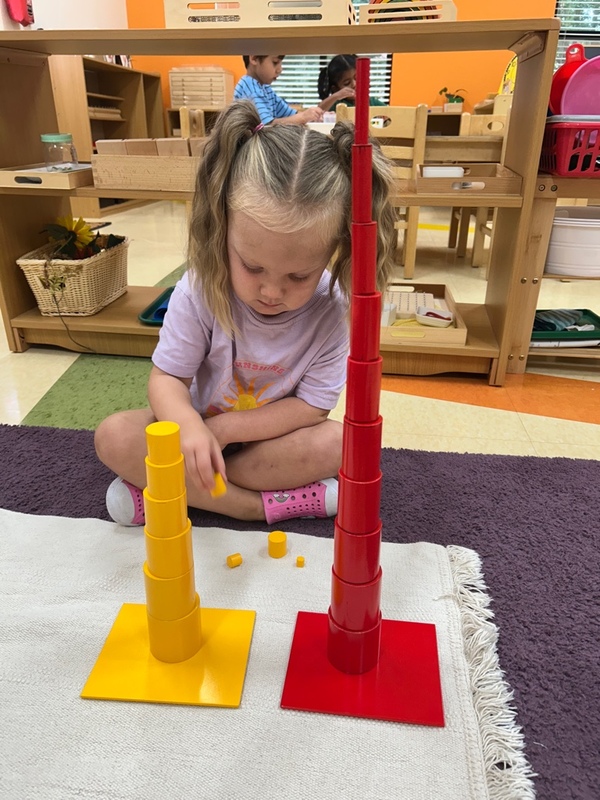
We believe children who have a strong, loving, consistent early-childhood experience grow into confident, happy, well-rounded individuals. Based on the Maria Montessori philosophy and model, our program blends teacher-planned and child-initiated activities in response to children’s interests — language, math, practical life, sensorial, cultural studies, zoology, geography, music, movement, art, and building are woven into every day, alongside regular meals, rest, and indoor and outdoor play.
Our Classrooms
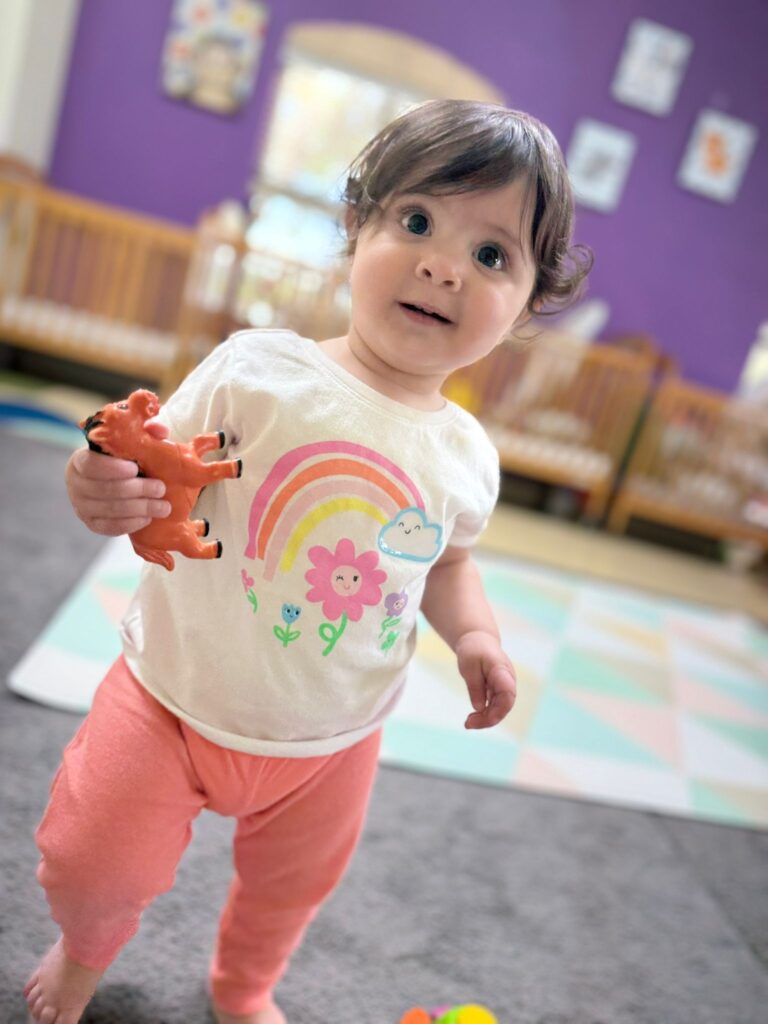
- Infants — Inchworm & Caterpillar (6 weeks–18 months). Visual development, sign language, verbal development, and motor experiences. Children eat, sleep, and play on their own individual schedules; parents provide an updated feeding schedule each month, and all bottles must be labeled and premixed.
- Walkers / Young Toddler (18 months–2+ years). Continued verbal development, sign language, fine and gross motor activities, and creative play. Children move to a single nap and self-feed at meals; art, music, language, literacy, and science are part of the daily routine.
- Transition Class (from 2½ years). Focuses on potty-training, language development, and cognitive growth to prepare children for the 3s program.
- 3s Program (age 3, fully potty-trained). Hands-on, developmentally appropriate activities across literacy, math, science, music, and art in classrooms organized for block play, manipulatives, art, dramatic play, and reading.
- Pre-Kindergarten I (early 4s). Prepares children for the transitional kindergarten curriculum.
- Transitional Kindergarten / Pre-K II (4+). Begins each school year in conjunction with Frisco ISD, for children who start Kindergarten the following year. Literacy, math concepts, and writing through hands-on, project-based learning in a child-driven environment.
Getting Ready for Kindergarten
By the end of Pre-K II, most children — each at their own pace — can:
- Language: recognize and write their first name, know most letter names and sounds, hear the first sound in a word, build simple three-letter words (like c-a-t) with the Moveable Alphabet, and retell a short story.
- Math: count to 20 and beyond, count objects one by one, recognize numerals 1–20, compare more and less, name basic shapes, and continue a simple pattern.
- Independence: dress, use the bathroom, and wash hands on their own, open their lunch containers, follow two- or three-step directions, and stay with one activity for 15–20 minutes.
- Getting along: take turns, share materials, and use words to solve a disagreement.
- Hands: hold a pencil with a three-finger grip and cut along a line with scissors.
These are goals, not a test — children grow at different rates. Your November/December conference shows where your child is and what we’re working on next.
Moving Up to the Next Classroom
Transitions are discussed with parents well in advance, and children “visit” their new class before moving. There is no formula: a child must meet the minimum age for the next room, and readiness — potty training, eating skills, motor development, and social/emotional growth — is always considered. A child still on a bottle, for example, isn’t ready to move up: beyond the toddler transition, bottles are discouraged so children can develop the oral skills that support speech. The Director approves every transition, also weighing current class sizes, ratios, and the ages of children in the receiving room.
Partnering with Parents
Formal parent conferences are held each November/December to review progress and set goals, and teachers are available to meet with you throughout the year — our door is always open. Each day you’ll receive an email with details of your child’s day, and families receive secure camera access to view their child’s classroom — approved extended family members (like grandparents) can receive their own login too. Camera access carries a small monthly fee (currently $25 per child per month), and the school may adjust or update this service from time to time. Parents are welcome to visit the center at any time during operating hours, without prior approval. If you think your child might have special needs, the Director can help you through the free school-district and Early Childhood Intervention screening and referral process.
Meals & Rest
- Breakfast, lunch, and snacks are provided daily (lunch catered by KidzCaters), with milk, water, and fresh fruit offered every day. Monthly menus are posted near the lobby.
- We are a nut-free school. Notify us in writing of any allergies or dietary restrictions; a physician’s statement and Allergy Action Plan are required for food allergies.
- If your child can’t participate in the school meal program, please provide a full, consistent substitution from home. Families of children on formula or baby food supply enough each day to meet their child’s needs.
- Children are always encouraged — never forced — to eat, and we’ll talk with you if any recurring eating concerns come up.
- Parents have the right to breastfeed or provide breast milk; a private nursing space is available.
- Breast milk: bring it in bottles labeled with your child’s name and the date it was expressed. We refrigerate it on arrival, warm it in warm water (never a microwave), and throw away any milk left in a bottle after a feeding. Unused bottles go home at the end of the day. Frozen milk should arrive frozen or already thawed in your fridge; thawed milk is never refrozen.
- Children 12 months and older in care five or more hours have a supervised rest period after lunch — typically 2 hours, with at least 1 hour of rest (sleep is never required; quiet activities follow).
Infant Safe Sleep
Our infant rooms follow the safe-sleep standards of Texas child care licensing, the American Academy of Pediatrics, and the Consumer Product Safety Commission. Infants are always placed on their backs to sleep, in their own CPSC-compliant crib with a firm mattress and tight-fitting sheet — and nothing else: no blankets, pillows, stuffed toys, bumpers, or positioning devices for infants under 12 months. Heads and faces are never covered, and if extra warmth is needed we use sleep clothing such as footed pajamas instead of blankets. Sleeping infants are actively observed by sight and sound, infants who fall asleep elsewhere (a swing, a car seat) are moved promptly to their crib, awake babies enjoy supervised tummy time daily, and swaddling or alternate sleep positions require a health-care professional’s written recommendation (HHSC Form 3019 — available from our front office, or take this form to your pediatrician). Families enrolling an infant review and sign the full policy (HHSC Form 2550) as part of their enrollment paperwork.
Animals & Classroom Pets
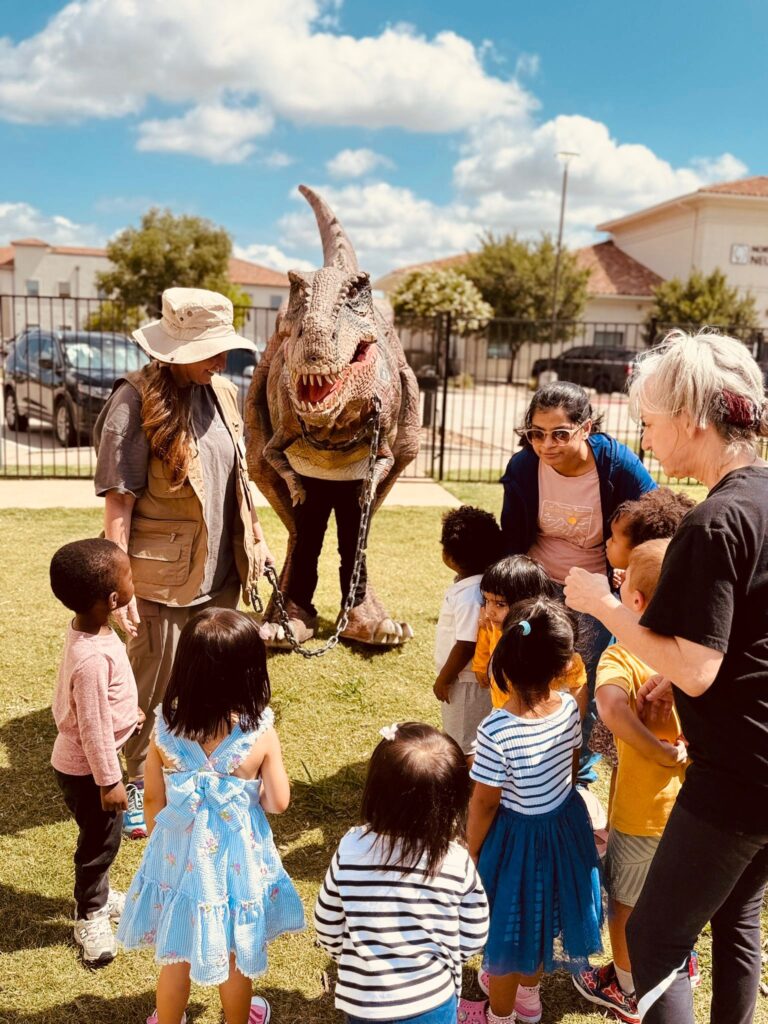
In support of our curriculum, children get to experience a variety of animals at the center — classroom pets may include fish and other aquatic friends, gerbils, hamsters, and hermit crabs, and visiting animal programs (like a petting zoo) join us from time to time. If your child has any animal allergies, please let us know in writing.
What to Bring (and Leave at Home)
Dress children for active, messy, indoor-and-outdoor play in labeled clothing with closed-toe, rubber-soled shoes, and keep two full sets of extra clothes at the center. Please leave toys at home — one soft comfort item for nap time may stay in your child’s cubby. Water play (sprinklers, water tables) requires permission and is announced at least 48 hours ahead.
Outdoor Play & Weather
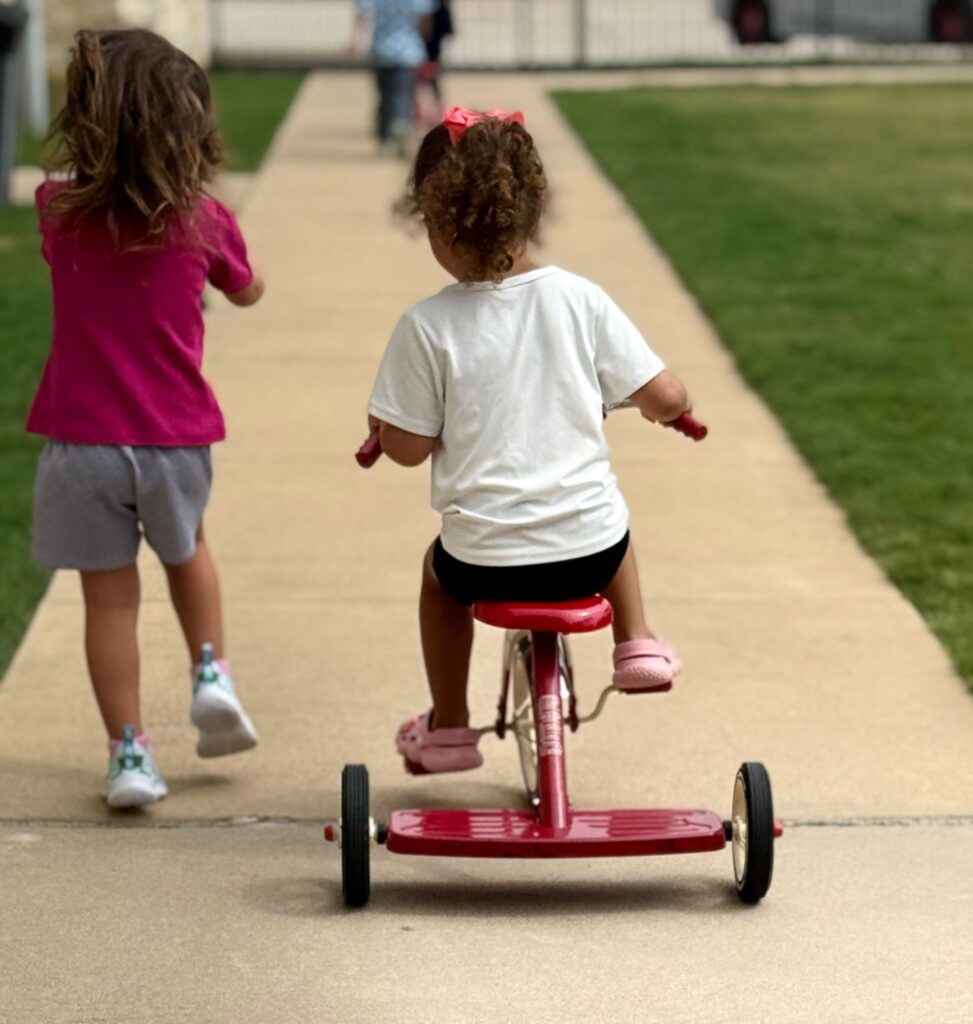
Children play outdoors every day, in the morning and the afternoon, unless the weather is unsafe — plus active play indoors. We check the heat index and wind chill before going out:
- Heat index 90–99°F: shorter outdoor time in the shade, with water breaks; we favor the cooler morning.
- Heat index 100°F or higher, or a heat advisory: active play moves indoors.
- Wind chill 20–32°F: shorter outdoor time in warm layers.
- Wind chill below 20°F, or a wind-chill advisory: active play moves indoors.
- Rain and storms: a short outdoor time in light rain is fine; at the first thunder or lightning everyone comes in and stays in until 30 minutes after the last thunder.
Please dress your child for the day’s weather: layers, a coat, hat, and gloves in winter; light clothing and a sun hat in summer. Please skip scarves and drawstrings, which can catch on play equipment.
Sunscreen & Insect Repellent
Please apply sunscreen (SPF 30 or higher) — and insect repellent when needed — at home before drop-off. With your written permission on the Topical Application Authorization form, teachers reapply before afternoon outdoor play, using your child’s own labeled product. Lotion or stick sunscreen is best; aerosol sprays can’t be used around the other children. Insect repellent should contain no more than 30% DEET and is never used on babies under 2 months. For babies under 6 months we rely on shade and clothing rather than sunscreen.
Drop-Off & Pick-Up
- Escort your child into the center, check in at the front-desk sign-in system every day, and walk them to their classroom. Children arriving early may settle into the morning-care room until 9:00 AM. Please arrive by 9:00 AM so children don’t miss the core curriculum.
- Children are released only to parents and adults you have authorized — anyone unfamiliar must be authorized in writing and show photo ID.
- Custody and court orders: unless a court order says otherwise, both parents have equal rights to visit and pick up their child. If a court order limits a parent’s access, please give the office a copy of the current, signed order — we follow it exactly. We stay neutral in family disputes: our staff don’t give statements or testimony except under subpoena, and the school can’t serve as a visitation or exchange site.
- Sign out at the front desk before going to the classroom, pick up your youngest child first, and keep children with you once released. Please refrain from cell-phone use in the building.
- Every family receives a personal key fob (please don’t share it); doors stay locked at all times and visitors ring the bell.
Parking
Please drive slowly and cautiously near the building and in the parking areas. The short-term spaces at the front are for drop-off and pick-up only; you may also use the loading/unloading lanes on the west side of the building, where additional parking is available too. For everyone’s safety, please don’t leave your car running or leave other children unattended in the car while you come inside.
Your Child’s First Day
Before starting: complete all enrollment forms, up-to-date immunization records, the health-care statement, tuition agreement, sign-in registration (pass and PIN) for pick-up, and camera-access activation. To ease the transition, visit the school together beforehand, have your child walk in on their own, stay positive, and keep goodbyes short and confident — then trust our teachers, and call or check the classroom camera any time.
Hours & Closures
The center is open Monday through Friday, 7:00 AM to 5:30 PM; full-day programs provide up to 10 hours of care. We close for major holidays — including Martin Luther King Day, Good Friday, Memorial Day, Independence Day, Labor Day, Columbus Day, Thanksgiving, staff-development days, a bad-weather makeup day, and winter break — please check the school calendar for exact closure and early-release dates. For inclement weather, we follow Frisco ISD closures, late starts, and early releases — closures and late starts are announced by email (and our school communication app), and early closures also by phone.
Enrollment
Enrollment fees — the Annual Registration Fee ($200 per child, charged at enrollment and each September 1) and the supply fee charged each March 1 and September 1 — are set out in your Tuition Fee Agreement. Before starting, children are invited to spend a Discovery Day with us, and all paperwork must be complete: enrollment forms, current immunization records, a physician-signed health-care statement, the tuition agreement, physician documentation for any food allergies, key-fob assignment, and sign-in registration (pass and PIN) for pick-up (plus a feeding schedule for infants).
Tuition & Fees
- Tuition is billed monthly in advance and is based on your child’s classroom level. Your Tuition Fee Agreement sets out your tuition and fees, billing dates, payment methods, the card processing fee, and what happens if a payment is returned or declined. If tuition goes unpaid, we may need to release your child’s spot (see Unpaid tuition under When Extra Support Is Needed).
- No credits or discounts are given for closures beyond our control, weather, holidays, illness, or absences shorter than a week.
- Absences of a week or more: with at least one month’s written notice before the first day away, tuition is prorated for an absence of a week or more. A week is 7 days, counting weekends and holidays, so the absence must cover at least 7 days in a row. That month’s tuition is reduced by the days away out of the days in the month — for example, one week away in a 30-day month takes 7/30 off — and is never more than your regular monthly tuition. Shorter absences, such as two or three days, are not prorated.
- Hold-spot fee (one time per leave): if your child will be away for a whole month or longer, including extended/summer breaks, you can keep your child’s spot with the Director’s approval and a one-time hold-spot fee — $250, or half of one month’s tuition for infants. The fee is applied toward your next month’s tuition and adjusted when you return. Holding the spot also saves you the new Annual Registration Fee that re-enrolling after a withdrawal requires.
- One promotional discount per child at a time (sibling discount on the oldest child excepted). Replacement key fobs are $20.
- Tuition rates and how they change, including periodic rate adjustments and moves to a new classroom level, program, or extended-care selection, are set out in your Tuition Fee Agreement.
- Family referral program: refer a new family and, when they enroll, both families receive $250 off tuition — credited after the referred family completes their first full month of enrollment.
- Graduated family referral bonus: families whose children have graduated or moved on from Creative Minds can still refer! A graduated family receives a $150 cash bonus for every referred family that enrolls and completes their first full month — and the newly enrolled family still receives their $250 tuition credit. There is no limit on referrals for either program. Create your personal referral link (and follow your campaign) at creativemindsmontessori.com/refer.
Withdrawal, Schedule Changes & Late Pick-Up
- Withdrawal: withdrawing your child requires 30 days’ written notice to the office, and tuition remains due through the end of the notice period. Billing for partial first and last months, and re-enrollment, are set out in your Tuition Fee Agreement.
- Schedule changes: permanent schedule changes need 2 weeks’ notice, and we cannot offer make-up, substitution, or temporary-change days.
- In the rare case where our environment isn’t the right fit for a child’s needs, the Director will partner with the family to find the best path forward — which may include helping the family transition to a setting better suited to their child.
- Late pick-up: any time your child stays beyond their scheduled time, the late pick-up fee set out in your Tuition Fee Agreement is charged for each occurrence. This applies after your program’s scheduled end — 4:00 PM for School Day programs, 11:30 AM for Half-Day programs — as well as past the 10-hour span or 5:30 PM. If you’re running late, please call with your estimated arrival so we can prepare your child (and reassure them!).
Safety & Security
Doors are locked at all times; each family receives a personal key fob and visitors must ring the bell. Parents check children in and out daily at the lobby sign-in system. For the safety and security of every child, the sign-in kiosk records the date, time, and a camera photo of each check-in and check-out; photos are stored securely and automatically deleted after 90 days. Video cameras cover the building and every classroom, with secure family viewing access, and teachers keep daily records (meals, naps, diaper changes) that are emailed to you each day. For every child’s privacy, photos that include other children may not be shared on social media, and parents may not take photos or videos in the school. The center is a designated gang-free zone under Texas law.
Weapons and smoking: weapons of any kind are not allowed in the building or on the playground; if you are licensed to carry, please leave your firearm locked in your vehicle. Smoking and vaping (including e-cigarettes) are not allowed anywhere on our property or near children.
Positive Discipline & Guidance
Discipline is individualized, consistent, and directed toward teaching acceptable behavior and self-control, using only positive methods: praise and encouragement, clear expectations, redirection, and brief supervised calm-down time (never more than one minute per year of age). Corporal punishment, humiliation, punishment tied to food, naps, or toileting, and all harsh treatment are strictly prohibited. Teachers treat challenging behavior as communication — observing, documenting, partnering with families, and building individual support plans when needed. Under Texas licensing, children under two have no screen time; older children may have at most one supplemental, education-aligned hour per day, never during meals or rest.
Biting is common among toddlers who are still finding their words. When it happens, we comfort and care for the child who was bitten, calmly tell the child who bit that biting hurts, and watch that child more closely to prevent the next one. Both families receive a written report the same day; we never share the other child’s name. If biting keeps happening, we meet with you and make a plan together, and on a day with repeated biting we may ask you to pick your child up early.
Bullying — repeatedly hurting, threatening, or leaving out another child on purpose — is taken seriously at every age. Teachers step in right away, help the children make it right, teach kindness and problem-solving, and let the families involved know.
When Extra Support Is Needed
We welcome children of all abilities and temperaments. Every decision in this section is made about an individual child’s actual needs and behavior in our program, never on a diagnosis or label alone, and suspending or ending a child’s enrollment is always a last resort.
How we work through it. When a pattern of challenging behavior or an unmet need emerges, we start with what works: observation and documentation, positive-guidance strategies, a meeting with the family, and an individualized support plan with reasonable changes to routines, activities, or the classroom that we can make within our licensed staffing. We review the plan with the family and keep written notes of what was tried and how it went.
When we may suspend or end enrollment. If one of the following continues after those documented efforts, the school may ask that a child take a short break from the program or may end the child’s enrollment:
- Level of care. The child needs sustained one-on-one supervision or care beyond what our licensed ratios and staffing provide, and reasonable changes have not made the day safe and workable. We are not able to add staff or assign a teacher to one child full-time. If a family offers a qualified personal aide at no cost to the school, we consider that as part of our review.
- Safety. Behavior that repeatedly puts the child, other children, or staff at risk of harm, such as hitting, biting, kicking, throwing objects, or leaving the group or the classroom.
- Persistent disruption. Behavior that, despite the support plan, persistently keeps the classroom from functioning, so that other children lose the care and learning they are enrolled for.
- Needs beyond our program. Health, care, or therapeutic needs that call for services, equipment, or specialized training our program is not licensed or staffed to provide.
- Partnership. The family declines to take part in the support process, such as meetings or the steps agreed in the support plan.
- Required records and safety policies. Enrollment, immunization, or health records that Texas licensing requires remain missing after reminders, or our health, pick-up, or safety policies are repeatedly not followed.
Adult conduct. Our classrooms must stay calm and safe for every child. Shouting, threats, profanity, or aggressive or intimidating behavior by a parent, guardian, or anyone picking up or visiting on a family’s behalf is not acceptable anywhere at the school, and especially in a classroom or in front of children. Staff may ask the adult to step out of the classroom and continue the conversation privately with the Director. Depending on how serious it is, the school may give a written warning or may end the child’s enrollment, including without a prior warning for threats, violence, or conduct that frightens or endangers children or staff. When anyone’s safety is at risk, we will call the police.
Unpaid tuition. Tuition and fees are due as set out in your Tuition Fee Agreement. When an account falls behind, we reach out to the family first. Ending a child’s enrollment over an unpaid balance is a management decision, based on the family’s willingness to work with us to bring the account current. Any balance still owed remains due after enrollment ends.
Enrollment may also end for other reasons set out elsewhere in this handbook and in your Tuition Fee Agreement, including communication that becomes harmful or disruptive.
Immediate safety. When a child’s behavior creates an immediate risk of serious harm to the child or others, we may ask a parent to pick the child up right away and may pause attendance while we meet with the family.
Notice and next steps. The Director discusses any decision to suspend or end enrollment with the family and confirms it in writing, with the reasons. We give as much notice as circumstances allow; removal without notice happens only when safety requires it. When a child’s needs are the reason, we share information about resources such as early-intervention and school-district evaluation programs, and we help the family transition to a setting better suited to their child.
Health, Illness & Medication
- We cannot care for sick children. A fever is 100.4°F or higher (forehead, ear, or mouth thermometer) or 99.4°F or higher under the arm. Children with a fever must stay home until fever-free for 24 hours without fever-reducing medicine; vomiting (two or more times in 24 hours) or diarrhea that isn’t controlled requires 24 symptom-free hours with normal eating; a child who needs antibiotics returns after at least 24 hours on them. Conditions like pinkeye, strep, impetigo, ringworm, chicken pox, measles, mumps, rubella, and head lice (we enforce a no-nit policy) have specific return-to-school criteria per the full policy.
- We may also ask that a child rest at home when their condition makes the day genuinely hard on them or the classroom — for example unusual exhaustion, persistent distress, or a temporary need for one-on-one care we can’t safely provide.
- Daily health observations: formal health checks aren’t conducted at arrival — children should arrive healthy — but our teachers watch throughout the day for signs like breathing difficulty, severe coughing, discharge from the nose or eyes, skin changes, bruising or swelling, and unusually warm or clammy skin, and we’ll always compare notes with you about sleep, appetite, toileting, and mood.
- If your child becomes ill at school, we’ll call you — please pick up within 45 minutes. Until you arrive, your child rests comfortably away from the group with a teacher close by. If symptoms become severe, we call 911 first and then you. Any concerns are documented and shared. For a diagnosed contagious illness, we may ask for a note from your child’s doctor before they return.
- Medication (prescription or over-the-counter) is administered only with a completed Medication Authorization form (completed by the parent, as the state requires), in its original labeled container, exactly per the label, and only to the child it’s prescribed for.
- Current immunization records are required before care begins. A valid record shows your child’s date of birth, each vaccine with the number and type of doses and the date each was received, and the physician’s signature or stamp (a machine or handwritten copy is fine). Please provide an updated copy after each new immunization.
- Vision & hearing screening is required by the Special Senses and Communication Disorders Act, Texas Health & Safety Code, Chapter 36, for children four and older: first-time enrollees age 4+, and children who turn 4 by September 1st, must be screened before the end of their first semester or within 120 days of enrollment (whichever is longer) — or provide evidence of a screening within the past year.
- Per state requirements, we maintain a policy on protecting children from vaccine-preventable diseases; staff members are not currently required to receive vaccinations.
Emergencies & Notifications
In an emergency our first responsibility is moving children to a designated safe area — our alternate locations are DUA Trattoria (5225 Warren Pkwy, 860-706-3879) and Tom Hicks Elementary School (3651 Compass Dr, 469-713-5981), with the Director bringing enrollment records along. In a medical emergency we contact you immediately (then your emergency contacts, two of whom must live or work within 15 miles), and in extreme cases transport to the nearest hospital or call 911. You’ll always be notified promptly of injuries, illness requiring exclusion, communicable-disease or lice outbreaks, policy changes (in writing), and pest control (48 hours ahead). Every caregiver completes at least 24 hours of training each year (30 for the Director), including dedicated training in preventing, recognizing, and reporting child abuse and neglect, as Texas law requires (confidential reports: 1-800-252-5400).
Drills: we practice a fire drill every month and a severe-weather drill and a lockdown drill four times a year each.
Lockdown: if there is a threat in or near the building, we lock every door, move children to secure rooms away from windows, keep them calm and together, and call 911. No one enters the building except police and emergency responders — please don’t come to the school during a lockdown. We’ll email and call with updates as soon as it is safe.
Reunification: after any emergency, children are released only to parents and authorized adults with photo ID, at the school or at the alternate location we name in our message. If we can’t reach you within an hour, we call your emergency contacts, and a teacher stays with your child until an authorized adult arrives.
Accident & Incident Reports
Minor bumps and scrapes are cared for at school, and you receive a written report in the Family Journal the same day; for head injuries or anything more serious, we call you right away. Please sign each report in the Family Journal within 48 hours — it takes one click. Signing only confirms that you have seen the report; it does not mean you agree with everything in it. The Journal records when a report is opened and signed. If you have questions or see something differently, please talk with the Director, who will add a note to the report.
Working Together
We ask that all communication with teachers and administration stay respectful and professional, with concerns brought directly to the Director — that’s the fastest path to a thoughtful solution, and it keeps our community supportive for children, families, and staff. In the rare case where communication becomes harmful or disruptive despite our best efforts, the school reserves the right to take appropriate steps, up to ending enrollment (see Adult conduct under When Extra Support Is Needed). Parents may visit at any time during operating hours, and anyone can volunteer at the center or on field trips after completing an 8-hour pre-certification and a criminal-history check. We welcome your questions about any policy, any time.
Private Arrangements with Staff
We kindly discourage independent babysitting arrangements between families and our employees. If you do arrange care with a Creative Minds employee outside their working hours, it must take place away from the school, with the clear understanding that they act as a private citizen — not as a Creative Minds employee — and the school isn’t responsible or liable for their actions off our property, including transporting children (a signed acknowledgment and waiver may be required). And if a staff member resigns to accept employment with your family, a $1,000 finder’s fee to Creative Minds applies — our teachers are the heart of the school, and recruiting and training their replacement is a real cost.
Your rights as a parent (26 TAC §746.521). You have the right to: enter and examine the center during operating hours without advance notice; file a complaint against the center; review the center’s publicly accessible records; review the written records we keep about your child; receive HHSC inspection reports and information on how to find the center’s compliance history online; have us follow a valid court order that prevents another parent or guardian from visiting or removing your child; receive contact information for Child Care Regulation (below); view an available video recording of an alleged incident of abuse or neglect involving your child (you may not keep footage showing other children, and the parents of other children shown are notified in writing first); obtain a copy of our policies and procedures; review our staff training records and in-house training curriculum on request; and exercise these rights without retaliation. Texas HHSC Child Care Regulation: 8700 N. Stemmons Fwy, Suite 104, Dallas, TX 75247 · 1-800-582-6036 · hhs.texas.gov. Minimum standards for child-care centers: hhs.texas.gov/providers/child-care-regulation/minimum-standards. Texas Abuse and Neglect Hotline: 1-800-252-5400 · txabusehotline.org.
This page is the current version of our Parent Handbook & Operational Policies. Creative Minds may update it from time to time, and families are notified when significant updates are made. The current school calendar is available from the front office — and we’re happy to answer questions about any policy: contact us or speak with the Director any time. Last updated September 29, 2026.