



The 100-item "must-have" checklist is a marketing document, not a syllabus: a newborn's real list is short — a correctly installed car seat, a firm, flat, bare sleep surface, food, diapers, a few clothes, and you. Spend your research hours and real money on the two safety-critical items, happily borrow or buy used almost everything else after a recall check, and hold the bright lines: no used car seats with unknown history, no pre-2011 or drop-side cribs, and no inclined sleepers or padded bumpers ever — they're banned for killing babies. Then put the money you didn't spend toward what actually matters: postpartum support and childcare (tour infant rooms while pregnant — waitlists are long, and the center provides most daytime gear anyway). This is not medical advice — your pediatrician and a certified car-seat technician beat any checklist.
The problem, in real voices
One New York mother — a writer in a small apartment — knew exactly what her problem was: she hated researching and planning, but the fear of being caught unprepared was stronger than the hate, so she bought far too much for a home with nowhere to put it. The moment that stayed with her wasn't about the stuff at all: pulling a shirt over her newborn's head upset him so badly that she found herself questioning whether she was fit to be a mother — over a shirt. It took a cross-country move with her second baby, packing four days' worth of clothes, books, and toys into a suitcase, to learn how little a baby actually requires. The gear anxiety and the competence anxiety, she realized, had been the same anxiety all along.
Another mother went the other direction on purpose. Ruthlessly practical, she skipped the tiny moccasins, refused the big-box registry, and treated most baby gadgets as clutter with a marketing budget. Then her husband surprised her with a $1,500 smart bassinet — and she complained about it out loud while secretly crying with relief on the inside. Her honest verdict afterward: minimalism with a newborn is mostly wishful thinking. Even the anti-stuff parents feel the pull.
And then there's the father who took inventory years later, like an auditor of his own nursery: the changing table, the wipe warmer, the video monitor, the sling, and the diaper pail all went essentially unused; the bottle sterilizer was used exactly once. His honest kicker, though, cut the other way — his wife would have been genuinely disappointed not to receive those gifts. The wanting and the using, it turns out, are two entirely different things, and both are real.
If you're forty browser tabs deep at midnight comparing bottle-nipple flow rates, none of this means you're uniquely indecisive. It means the assignment was rigged: the standard registry checklist was written to be unfinishable — because the people who wrote it are selling the items on it.
What's really going on underneath
Start with the math of the mismatch. The standard retailer checklist runs 100 to 120 items, and by the registry industry's own (self-flattering, so take it as directional) accounting, the average registry's listed value lands around three thousand dollars — and expecting parents report spending something like a full work week researching it all. Set that against what a newborn actually requires: a safe car seat, a safe place to sleep, food, diapers, a handful of clothes, and warm adults who show up. Everything else on the list — every warmer, station, system, and set — is optional. The gap between those two lists is not your confusion. It's the business model.
Because the registry is the marketing funnel. The American baby-gear space is worth tens of billions of dollars, and a first-time parent who doesn't yet know what they need is the ideal customer for a checklist written by a retailer. The emotional mechanism is precise: an expecting parent's deepest fear is that they won't be able to adequately care for this baby, and products are positioned as competence you can purchase — the smart sock, the tracking scale, the monitor that watches the monitor. Buying feels like preparing, which is exactly why the anxiety never ends at the checkout: you can't purchase your way to feeling ready. One father's old joke still lands: pick any verb your baby will do and any noun for where they'll do it, and there is a product for that exact combination, probably with a cartoon character on it. The choice overload is a design feature, not an accident.
And the stakes underneath are genuinely high, which is why the anxiety feels rational rather than silly. One large 2025 parenting-media survey put the average first year with a baby at more than twenty thousand dollars — up sharply in just a few years — and found that the overwhelming majority of surveyed mothers said finances weighed on their mental health. There's an identity layer too: at 2 a.m., registry choices get read as statements about what kind of parent you'll be — organic, tech-optimized, frugal, minimalist. That's how a bassinet choice produces tears. And notice the two-sided trap: maximalism says buy everything or you're unprepared, while minimalism-as-content says a good parent needs almost nothing — so now under-buying is also a performance you can fail. The curated "minimalist registry" is still a list, still selling you its picks.
How the Layette Became a 100-Item Store List
Expecting families have always assembled a kit for the new baby — it's called a layette, and it's centuries old. In the 1920s it was typically hand-knitted by the mother or her relatives: a blanket, a hat, a sweater, booties. The list was short because hands, not factories, made it. There has never been a strict definition of what a layette must contain — which is exactly why the list could grow without limit once someone was selling it. The handmade bundle became a purchased "layette set," then a store department, then a 100-item digital registry. What changed over a century isn't what babies need — it's that the list got an owner, and the owner is a store. Parents were writing "baby-industrial complex" essays about drowning in specialized gear in 2009 and 2013, before Instagram had ads. Each generation gets a bigger catalog and the same fear.
What the phone adds is reach and intimacy. Targeted advertising knows you're pregnant — in one famous case, a retailer's purchase-pattern models flagged a teenager's pregnancy before her father knew, and retailers learned to camouflage baby ads among unrelated ones precisely so the targeting wouldn't feel like surveillance. The second trimester is the industry's prime acquisition window, and brands actively recruit pregnant creators because a "my registry must-haves" video reads as peer advice rather than advertising. Meanwhile the comparison feed delivers other people's nurseries pre-staged and sponsored, to compete with your Ikea-and-hand-me-downs reality. But the same phone genuinely helps where it counts: the CPSC recall database and SaferProducts.gov let you vet any used or gifted item by model number in one search — something no 1980s parent could do. Buy Nothing groups and local marketplaces move barely-used gear between families at scale (one family furnished nearly everything free, including a donated stroller that retailed for over a thousand dollars). And modern cash-fund registries let your people fund meals and doula hours instead of objects.
How parents usually try to fix it — and the catch
Three of the most common moves, honestly:
- Register for everything, "just in case." The upside: working the full checklist genuinely reduces decision fatigue later, gift-givers fund a large share of it (the registry industry itself claims most items get purchased for you), and nothing catches you unprepared at 3 a.m. The catch: the never-used pile is boringly predictable — wipe warmers, bottle warmers, baby-food makers, newborn shoes, and changing tables recur on virtually every regret list ever written. The storage burden lands during your most chaotic months, clutter itself becomes a documented stressor for new parents, and the spending displaces money the twenty-thousand-dollar first year will want back.
- Hardline minimalism. The upside: real savings, less clutter, and it correctly identifies the honest core — most gear is optional. The catch: its own practitioners admit minimalism with a newborn is mostly wishful thinking. Some conveniences earn their shelf space — a bouncer that buys you a shower, a bassinet that buys you sleep — and a rigid pledge turns into its own shame spiral the day you cave. Refusing all gifts also blocks a real love language: for grandparents and friends, the stuff is the saying-I-love-you.
- Secondhand everything. The upside: massive savings (one family spent twenty dollars total on new gear), environmental sanity, and the deep truth that babies outgrow items so fast that used usually means barely used — the sixty-dollar snowsuit for three dollars, tags still on. The catch is the safety line people miss: a short list of categories should essentially never be secondhand — car seats, older cribs, used crib mattresses, breast-pump motors, and any inclined sleeper or padded bumper (the full list is below). Recalled and banned products are illegal to sell, but secondhand marketplaces are weakly policed — the checking falls to you.
None of these make you a bad parent. They're rational responses to an irrational list — which is why the real fixes below are about shrinking the problem, not shopping it better.
How two parents often experience it differently
Hold this as a tendency, not a rule. The pregnant partner is usually the one marinating in the content — the apps, the targeted ads, and the registry checklists all aim at her from the second trimester on — so she often carries both the research load and the anxiety load. The other partner sees the pile of boxes and the credit-card bill and reads it as excess. Both are reacting to something real: she to manufactured urgency, they to actual money. The reverse split happens too, and it's worth naming kindly: sometimes the non-pregnant partner goes gear-maximal, because researching spec sheets is a socially sanctioned way to participate in a pregnancy happening in someone else's body — remember the husband and the surprise bassinet. Gear can be a love language and an anxiety outlet for the partner who can't gestate. Either way, the fight is rarely about the wipe warmer; it's about whether the family feels ready, with money stress as the accelerant.
The shape of the fix is the same for every family shape. Set the gear budget together before building the registry. Split research domains by interest, not by gender — one of you owns car-seat research, the other owns the sleep setup. And most powerfully: agree on the short needs list first, so that every later disagreement is explicitly about nice-to-haves — which drops the temperature of the whole conversation. For single parents, the registry math flips: with no partner to split the research, the gift network matters more, and a registry is partly how your village funds you — don't let minimalist guilt block that support. For same-sex couples and adoptive or surrogacy paths, neither of you may be the algorithm's "pregnant user," which can mean blissfully less ad pressure or feeling invisible in a registry world built around bump culture. The needs list is identical either way. And across all family shapes, remember the grandfather's inventory: much of the eventual pile is gifts you didn't choose, given in love. Build the registry so love has somewhere useful to land.
Better ways that actually work — introduced gently
The principle across all three: you can't research your way to certainty about a person who hasn't arrived yet — you can only shrink the list, aim the money at the actual risk, and let everything else arrive used, borrowed, or later.
1. Write two lists — needs first, everything else after
The reason this works is almost mechanical: a newborn's true needs list is short and knowable, so separating it from the wants list converts an infinite comparison problem into a small, finishable one. Preparation stops being a lifestyle and becomes a bounded task with an end. The needs list, roughly: a car seat; a sleep surface meeting current federal standards (crib, bassinet, or play yard) with a firm mattress and two or three fitted sheets; your feeding plan's supplies (pump and bottles, or a formula kit); diapers and wipes; eight to ten basic outfits (kimono-style tops sidestep the over-the-head wrestling that made one mother cry); some way to hold the baby hands-free; and a thermometer with a basic health kit. That's the whole syllabus. A bassinet covers roughly the first six months, so even the crib can wait.
Run it in order, starting around the second trimester: write the needs list first, from a non-retailer source; research and register those items to done-ness; then add nice-to-haves you actually anticipate, making each one answer three questions — is it necessary, can we borrow it, can we get it used? For everything else, adopt the rule that saves the most money and sanity: buy it when a real problem appears. Stores deliver in a day; you do not need to pre-solve hypothetical problems in your seventh month. By the third trimester the needs list should be finished and installed; after the birth, the buy-as-needed rule handles the rest. Frame it to partners and grandparents as "the important list is done — everything else is bonus," which honors gift-givers without inviting the avalanche, and consider registering for postpartum support (meals, doula hours, a cash fund) alongside objects. The sabotaging mistake is opening the retailer's checklist first and letting it define the categories — do that, and the wants quietly re-badge themselves as needs, and the task becomes infinite again.
2. Spend where the risk is — the car seat and the sleep space
Gear risk is not evenly distributed; it is wildly concentrated. The car seat and the sleep environment are the only two registry categories where product choices genuinely affect survival — nearly everything else is preference wearing a safety costume. So the method is to spend research hours and dollars proportionally to risk instead of proportionally to marketing volume. For the car seat: buy it new, or only from someone whose full history you know; register it with the manufacturer so recall notices reach you; plan rear-facing from birth; and get the installation checked — certified child passenger safety technicians do it free (find one through Safe Kids or NHTSA). The best seat is not the most expensive one; it's the one that fits your child and your car and gets used correctly every single time. For sleep: any crib made after the 2011 federal standard, or any product legally marketed for infant sleep after the June 2021 federal rule, meets crib-grade requirements — firm, flat, with a tight fitted sheet and nothing else in it.
By stage, this compresses neatly: research the two categories in the second trimester, buy and install in the third, and have the install checked before your due date — hospitals expect the seat at discharge. Then cheerfully go cheap, used, or borrowed on nearly everything else, without guilt, because the two things that matter are done. What to expect is the quiet payoff veteran parents report: "we got the two big things right" is a finish line, and it beats "we bought all 120 things" as a definition of ready — especially for an anxious partner who needs somewhere concrete to put the worry. The sabotaging mistake is spreading your research budget evenly across the whole checklist, agonizing equally over bottle brands and crash protection — that's the marketing's sense of proportion, not the risk's.
3. Run the secondhand playbook — with bright lines
Babies use most gear for weeks to months, which makes the secondhand economy the sane default — provided you hold a short list of bright lines, which is what most casual thrifters skip. Green-light used freely: clothes, books, toys (after a recall check), bathtubs, furniture, storage, decor, and blankets used as play mats. Yellow-light — fine if complete, uncracked, unrecalled, and ideally from someone you trust: strollers, high chairs, carriers, play mats, monitors, and activity centers. Red-light, never used regardless of condition: car seats (crash history is invisible, seats expire, manuals and parts go missing), cribs made before 2011 and any drop-side crib, used crib mattresses, breast-pump motors and bottle nipples (you can't sterilize what you can't see), and any inclined sleeper or padded crib bumper — those last two aren't merely risky, they're banned products that still circulate on marketplaces.
The how-to is a rhythm you set up early in pregnancy: join the local Buy Nothing and parent-swap groups now, before you need them; check every used or gifted item's model number against the CPSC recall database or SaferProducts.gov (selling recalled goods is illegal, but enforcement on marketplaces is weak, so the buyer checks); tell friends and family plainly that you welcome hand-me-downs, because generosity flows when people know it's wanted; and plan the exit — gear leaves your house the same way it came in. This works at every stage: pregnancy is for joining networks and gathering, the newborn months are for the buy-as-needed valve, and the outgrown-every-three-months year afterward is where the savings compound. One framing makes the family politics easy: post the red-light list where partners and gifting grandparents can see it, which converts "we're being cheap" into "we follow the safety rules." The sabotaging mistake is trusting the marketplace to have done the checking — the listing that reclines, pads, or looks like a cozy nest is exactly the one that was banned.
From the baby's side
Here is the entire spec sheet, from the customer's perspective. A newborn perceives faces at about nursing distance, voices, warmth, milk, motion, and the feeling of being held. A newborn cannot tell a $1,500 bassinet from a borrowed one, a curated nursery from a dresser drawer, or an heirloom blanket from a hospital-grade one — babies genuinely don't distinguish expensive items from household objects. The nursery aesthetic is for the adults, which is allowed; just name it as yours. What the baby "asks" of all that gear is short: keep me safe in the car, give me a firm flat bare place to sleep, feed me, keep me warm and dry, and be near me. And the one thing the stuff can actually crowd out is the thing no store sells: a rested, financially unstressed, comparison-free parent. A depleted parent is worse for a baby than any missing gadget, and the strongest "product" for infant development is a regulated caregiver — which is the best argument going for spending on support instead of objects. Your baby has never seen a registry. The baby's list has six things on it, and you're four of them.
Why the Infant Room Shrinks Your Registry
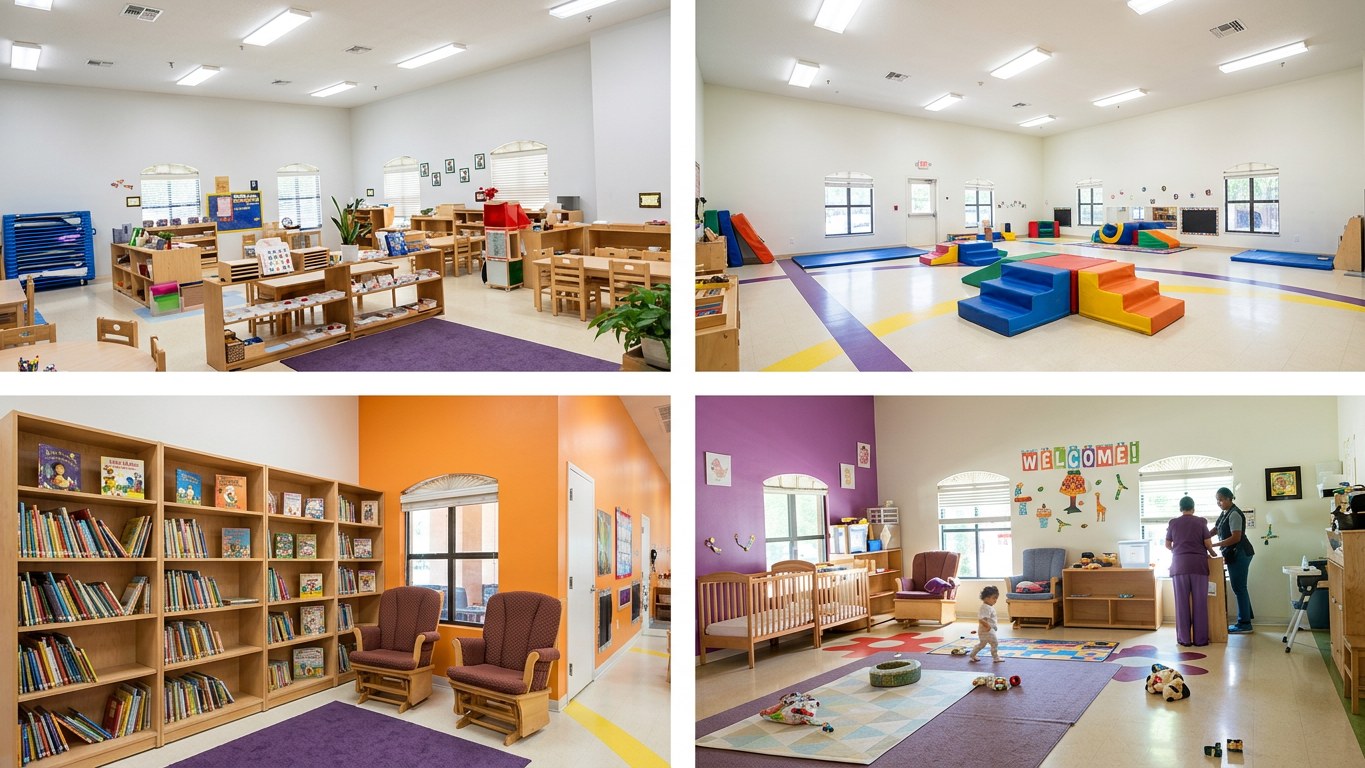
Here's why childcare belongs in a registry article: in many markets, infant-room waitlists run from months to a year, so touring centers and joining lists while pregnant is normal, not neurotic. And childcare — not gear — is the biggest line item of the first year, which means every dollar of registry restraint is a dollar funding the thing that actually matters. There's a gear payoff too, and it shrinks your list directly: a licensed infant room supplies most daytime equipment — cribs meeting the same federal standards you're learning about, usually the sheets, and sometimes even formula or diapers. What parents typically send is small: labeled bottles (enough for the day plus a spare), milk packed to the center's protocol or pre-measured formula, a pack of diapers and wipes replenished when staff flag it, a couple of changes of clothes, and a sleep sack. You do not need to buy a second full setup for daycare.
Touring while expecting also gets you something no checklist can: a sales-free second opinion. Ask any infant room the safety-literate questions — Do your cribs meet current CPSC standards? Is your sleep policy AAP-aligned: alone, on the back, bare crib, nothing added, no inclined products? What do you provide versus what do we send? How do you handle breast-milk storage and warming? Do you keep feeding logs and send daily reports? How do you support the transition — gradual starts, mid-day visits for nursing parents? A center that answers crisply has trained staff, and an experienced infant teacher who has seen hundreds of newborns will happily tell you which gear families actually use — trained observation beats influencer lists every time. A weak center shows the reverse tells: vague answers on safe sleep, gear-shaming, or a branded product list of its own. And the quiet gift of choosing well: when home and center follow the same safe-sleep script, every nap in your baby's life runs on one consistent set of rules — which is the beginning of the three-way partnership, before your child can say a word of it.
The safety non-negotiables
This is not medical advice — it's general safety information. Talk to your OB or midwife and your pediatrician about your situation, and to a certified child passenger safety technician about your seat. Almost everything in this article is preference. These four paragraphs are not.
Safe sleep. Baby sleeps alone, on the back, on a firm, flat surface that meets current federal standards — a crib, bassinet, portable crib, or play yard — with a tight fitted sheet and nothing else: no pillows, blankets, quilts, bumpers, positioners, weighted sleepers or swaddles, or stuffed toys. Room-share (baby's own surface in your room) ideally for the first six months — it's associated with a substantially lower risk of sleep-related death. No bed-sharing, and no sleeping in swings, loungers, or pillow-like nests; falling asleep with an infant on a couch or armchair is among the most dangerous arrangements known.
Banned products still circulating. Inclined sleepers and padded crib bumpers are banned hazardous products under the Safe Sleep for Babies Act — illegal to sell, yet they keep resurfacing secondhand. One recalled inclined sleeper alone has been linked to roughly a hundred infant deaths, dozens of them after the recall, precisely because recalled products keep circulating as hand-me-downs. If a hand-me-down sleep product reclines, pads, or "nests," the answer is no — regardless of condition, brand, or how sweetly it was offered.
Car seat. Rear-facing from birth, and keep rear-facing as long as the seat's height and weight limits allow. Never use a seat that has been in a moderate or severe crash, is expired or of unknown age, is missing labels, parts, or its manual, or has been recalled — which is why a used seat with an unknown history is never worth the savings. Register the seat for recall notices, and get the installation checked free through Safe Kids or NHTSA's hotline.
Cribs. The current federal crib standard dates to 2011, and drop-side cribs are banned. Politely decline the attic crib unless it's verifiably post-2011, unrecalled, with intact hardware — and pair any crib with a new, firm mattress.
Every Family Is Different — Trust Yourself
Two truths get to coexist here. Most of the registry is genuinely optional, and some optional thing will genuinely save your particular sanity — and nobody can tell you in advance which one it is. Not the 120-item checklist, and not the minimalist influencer either. For one family it's the bouncer that buys a daily shower; for another it's the bassinet that buys sleep; for a third it's none of the above and a meal train instead. A doula who spent years inside other families' postpartum homes put it plainly: no pile of products ever made a family feel ready — what eased the transition was rest, food, help, and a cared-for mother, none of it stocked at a big-box store. Both directions of judgment are noise: over-buyers aren't fools (they're scared and generous), and under-buyers aren't saints (sometimes they're just performing a different list). Preparation was never a pile of objects. It's the two safety calls made correctly, a short list finished, a support plan for the humans, and permission to solve every other problem when it actually arrives — next-day-delivered if needed. Your baby has never seen an influencer's nursery. Get the car seat and the sleep space right, keep the receipts, and trust that you — not your stuff — are the thing your baby needs.
Related struggles
- Registry restraint funds the real first-year line item → How much does childcare actually cost?
- The safe-sleep setup is where sleep habits begin → Baby won't sleep? Why it happens and what helps
- Touring infant rooms while pregnant → How to choose a daycare you trust
- Forty hours of registry research is mental load with a bow on it → The mental load of motherhood
Sources: AAP / HealthyChildren.org (safe sleep; car safety seats); CPSC (Safe Sleep for Babies Act guidance; recall database); Consumer Reports (used baby gear safety; Rock 'n Play post-recall deaths); NPR (Rock 'n Play recall re-announcement); registry-industry self-reported data (Babylist, MyRegistry) treated as directional; BabyCenter 2025 first-year cost research via news summary; Frugalwoods; parent and doula essays (Tiny Pals, Worthy Pause, Carson Meyer, Pregnant Chicken); Smithsonian collection and layette history; Forbes (retail pregnancy targeting); Denver Early Childhood Council and center packing guides. Stories are drawn from real parents' experiences; names and identifying details have been changed for privacy.