



Actual Size
A teacher’s look at why this book belongs in the The Why-Askers stage.
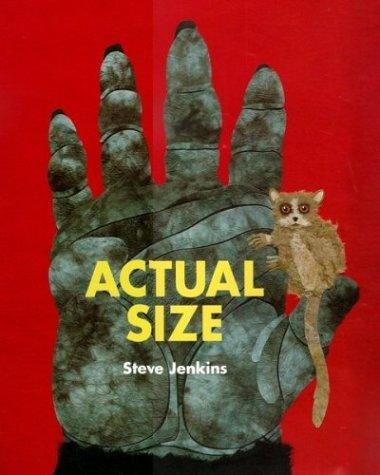
Why it fits The Why-Askers (for preschoolers whose every page sparks a question)
Animal parts printed at true scale: a gorilla's hand, a giant squid's eye. Children measure themselves against the pages bodily, which is how they think. Makes 'how big?' a question with a touchable answer.
What makes it special
The concept is irresistible: everything printed at true scale, so a child's hand measures against a gorilla's. Jenkins' cut-paper collages have a tactile, museum-diorama realism that makes the comparisons visceral. No screen can do this — a phone showing a gorilla hand is phone-sized, and children grasp that difference immediately.
From the publisher
Discusses and gives examples of the size and weight of various animals and parts of…
About Steve Jenkins
Steve Jenkins (1952-2021) wrote, illustrated and art-directed more than eighty nonfiction books for children, working in detailed cut- and torn-paper collage. What Do You Do with a Tail Like This?, made with his wife Robin Page, was a 2004 Caldecott Honor book.
His father was a physics professor and astronomer who did science experiments and animal drawings with him as a boy. At North Carolina State University's School of Design, Jenkins chose graphic design over science on a whim.
Also by this author: What Do You Do with a Tail Like This? · Biggest, Strongest, Fastest · Down, Down, Down
More from “How the World Works”
This book is part of The Best Books for Preschoolers: 30 Teacher Picks (The Why-Askers) in our guide The Best Children’s Books by Age — 120 books chosen by the Montessori-certified teachers at Creative Minds Montessori in Frisco, TX. Come see how we build readers →
Nobody paid for this review — not the author, not the publisher — and the store link above earns us nothing. Our only interest is the reader this book fits.