



Parental burnout is a real, named syndrome — not a character flaw and not ordinary tiredness. It has four specific dimensions: exhaustion in the parenting role, emotional distancing from your children, a feeling of being a bad parent, and a painful contrast with the parent you used to be. It's common — roughly 1 in 8 parents, and in the 2024 Surgeon General's advisory 48% of parents said their stress is completely overwhelming most days (versus 26% of other adults). The mechanism is simple and impersonal: demands have outrun your resources for too long. What helps isn't trying harder — it's tiny restorative acts anchored to your existing routine, rebuilding even a small village, and dropping the perfect-parent script (perfectionism is itself a documented risk factor). And one thing to take seriously today: burnout raises escape ideation and suicidal thoughts more than job burnout or depression do. If that's in your head, call 988 now. (Not medical advice.)
The problem, in real voices
A mother of a three-year-old and a seven-month-old described being touched constantly — the toddler wanting to be held all day, the baby nursing while scratching and pulling at her skin. She hits her limit before lunch, every day, and just wants five minutes inside her own body. She kept prefacing it with I love my kids — that reflexive cushion parents put under a hard sentence before saying it.
A father found himself yelling at his son for spilling water. A cup of water. His tank was so empty that a small accident registered as a catastrophe he couldn't handle, and the yelling frightened him more than the mess did.
A working mother of two hit her wall when her employer mandated a return to the office while she was already juggling childcare logistics, work travel, and the household. She described being pulled in every direction at once, with no decision left that felt like hers.
Another mother's first instinct when she got overwhelmed was to cut the things keeping her upright — exercise, rest, downtime. She got chronic pain and insomnia in exchange, and eventually left her job to recover.
And in a study of exhausted mothers, one described functioning robotically for months, going through the motions and feeling emotionally distanced from her own children — like a stranger in her own life.
Two things run through all of it. The exhaustion isn't the kind that sleep fixes. And every single parent felt they had to apologize before describing it.
What's really going on underneath
This has a clinical definition, and knowing it helps, because most parents assume they're just weak. Parental burnout was characterized in research in 2019 and has four dimensions: overwhelming exhaustion specifically in the parental role; emotional distancing from your children; a sense of ineffectiveness — I'm not a good parent; and a painful contrast with the parent you used to be. That last one is the tell. Burnout doesn't feel like tiredness. It feels like becoming someone else.
And it is genuinely distinct from depression. Research shows burnout's severe outcomes remain robust even after statistically controlling for depression and job burnout — it isn't depression wearing a parenting costume, and it isn't work stress following you home. It's tied specifically to the parenting role.
The mechanism is impersonal, which is the most useful thing about it: chronic imbalance between demands and resources. When the daily demands of parenting persistently outstrip the rest, support, money, and coping capacity available to meet them, burnout accumulates. It's an equation tipping the wrong way over months, not a verdict on your character. And it's common: roughly one in eight parents experiences it, while the 2024 U.S. Surgeon General's advisory found 48% of parents say their stress is completely overwhelming most days compared with 26% of other adults, and 41% say they're so stressed they can't function most days.
The documented risk factors are worth reading, because they're mostly circumstances rather than failings: a child's chronic illness or difficult temperament, lack of social and family support, high social expectations toward parents, co-parenting conflict, a parent's own difficulty with emotional regulation, and child-oriented perfectionism — the drive to be the perfect parent, which is a risk factor, not a protection.
But the emotional core isn't exhaustion at all. When researchers actually listened to burned-out mothers, the thread running through everything was fear: fear of not being good enough, fear the child feels unloved, fear about who the child will become, fear of losing control. Alongside it sat guilt and shame — measuring against impossible standards and feeling ashamed even to say so out loud — plus a loss of identity that they described as a break in the continuity of self.
And underneath all of it, usually, is the mental load: the cognitive household labor of planning, tracking, remembering, and anticipating. It's invisible, unpaid, and never clocks out. Neurologically, carrying it keeps executive function firing more or less constantly, and without recovery breaks that produces impaired decision-making and reduced emotional regulation — which is precisely why a burned-out parent snaps over a spilled cup of water. It isn't a temper problem. It's an unrested prefrontal cortex.
We Were Built to Alloparent — Now We Parent Alone
Here's the historical fact that reframes everything: parents were never meant to do this alone, and for most of human history they didn't. For tens of thousands of years humans raised children communally — groups of twenty or more, multiple generations, neighbors, friends, and older children all pitching in. Anthropologists call it alloparenting, from the Greek allo, meaning "other." "It takes a village" isn't an aspirational slogan. It's a description of the historical default.
Which means we're running an experiment. As psychiatrist Bruce Perry has pointed out, at no other time in human history have we asked one or two adults to meet all of a child's physical, emotional, social, and spiritual needs. The isolation is the new variable, not the difficulty of children.
And the strongest evidence that this is structural rather than personal: parental burnout rates are highest in individualistic Western cultures and lower in collectivist ones. If burnout were about individual weakness, it wouldn't cluster by culture.
The job description changed too. Parenting once centered on keeping children safe, fed, and healthy. Modern intensive parenting layered on enrichment, emotional attunement, developmental optimization, and curated experiences — none of which can be completed, all of which raise the demand side of the equation permanently.
Then the phones, which amplify it in three measurable ways. Comparison: social-media parenting groups drive social comparison that's linked to parental burnout through the emotions those comparisons stir — the sense that everyone else is managing. The screen-time guilt loop: parents cycle between allowing and restricting their children's screens and feel guilt either way, and research finds the stress comes less from the screen time itself than from the guilt about it, which lowers parent-child relationship satisfaction. And the parent's own phone: on days when parents feel they've been less responsive to their infant, their own smartphone use is associated with more depressive symptoms. Note the crucial moderator, though — when parents feel they have been responsive, phone use shows no such link. It isn't the device. It's the guilt. The Surgeon General's advisory names difficulty managing technology and social media explicitly, alongside financial strain and isolation.
Where the technology genuinely helps: the same phone connects an isolated parent to real support communities and to telehealth therapy that fits between naps, and shared calendars and task apps can make the invisible mental load visible — which is the necessary first step before it can be split.
How parents usually try to fix it — and the catch
- Push through, and cut your own maintenance first. (All ages, especially the infant crunch.) The upside: it keeps the household running, it feels responsible, and in an acute newborn stretch it's sometimes genuinely necessary. The catch: it's the single biggest accelerant. Exercise, rest, and downtime are the resources side of the demand-resource equation — deleting them doesn't reduce the load, it removes your capacity to carry it. The mother who cut exercise and rest first got chronic pain and insomnia, then had to leave her job entirely. Sacrificing yourself first isn't efficiency. It's spending the principal.
- A drink to take the edge off — "wine mom" culture. (Toddler and preschool years, the classic witching-hour cope.) The upside: culturally normalized, social, and it genuinely feels like a reward and a release valve after a brutal day. The catch: it disguises a potential problem as self-care. Two or more glasses to buffer the hard hours makes the next day twice as hard, and alcohol is a depressant — it worsens anxiety and low mood rather than relieving them, while being dependence-forming and progressive. The joke gets funnier as the pattern gets worse, which is what makes it hard to see.
- Individual self-care as the whole fix — the bath, the spa day, "me time." (All ages.) The upside: micro-recovery is genuinely protective, and small restorative acts really do help (that's method one below). The catch: framed as the solution, it hands the problem back to the exhausted individual and quietly excuses the structural causes. A bath does not fix an unfair division of labor, no paid leave, unaffordable childcare, or a partner who isn't sharing the load. For many parents, real recovery needs mental-health treatment plus partner participation plus a functioning support system — not a longer bath.
And the one that hurts most to name: try harder, do more, be the perfect parent. (All ages.) It comes from love and high standards. But child-oriented perfectionism is a documented risk factor for burnout, and "trying harder" is by definition adding to the demand side. The research-backed move is to abandon the cult of the perfect parent, not to optimize it.
How two parents often experience it differently
Tendencies, not rules — and the numbers are closer than the stereotypes suggest.
Start with the split that drives most of it. On average, mothers carry roughly 71% of the household mental load versus about 29% for fathers, and for daily repetitive tasks the gap is wider still. One parent becomes the default — the one who absorbs the invisible labor by reflex — and resentment is not a character flaw in that person; it's a signal pointing at the imbalance.
Then the perception gap that turns it into a fight: fathers consistently overestimate their own contribution, often describing the split as equal when the other partner experiences it as lopsided. Both partners then feel unseen, which is why this argument goes nowhere on vibes and only moves on specifics.
But both parents burn out. In one survey 55% of mothers versus 44% of fathers reported feeling burned out — a real gap, and not the chasm the culture implies. Fathers' burnout has a distinct shape: dads more often have smaller, less supportive social networks and perceive more isolation, so their distress stays hidden and rarely gets screened. Paternal postpartum depression is real, fathers' depressive symptoms tend to rise across a child's first five years, and paternal perinatal anxiety runs somewhere around 2 to 18%. Fathers' burnout is usually the quiet one — less voiced, less asked about, and therefore less treated.
Single parents carry sole caregiving, financial strain, and no one to hand off to, and often manage more invisible labor than partnered parents with no relief valve at all. If that's you, the "share the care" method below isn't optional advice — it's the whole intervention, and it has to come from outside the household.
LGBTQ+ parents carry every driver above plus minority stress — internalized stigma, perceived discrimination, everyday microaggressions — which depletes the same resource pool parenting draws on. Worth naming the flip side, though: same-sex couples more often report a deliberately negotiated division of labor rather than one that defaulted along gender lines, and that explicit negotiation is protective. It's a genuine strength other families could copy.
Turning the clash into teamwork takes four concrete moves. Name the mental load out loud with specific examples rather than a general accusation. Make it visible on a shared calendar or list so both people can see the real split instead of arguing about impressions. Challenge auto-defaulting when it happens. And hand off whole domains — not "help me with bedtime" but "you own bedtime, including remembering it." Where it's available, gender-neutral leave and flexible work do more than any conversation.
Better ways that actually work — introduced gently
All three converge on one idea, which is also the Montessori idea of the prepared adult: regulate the adult and you regulate the room. You are the environment your child grows in — and environments need maintenance.
1. Redefine self-care as tiny acts anchored to your existing routine
The mechanism here is twofold. First, behavioral: small tweaks accumulate into real change, while big plans requiring resources you don't have simply never happen — which is why "schedule a spa day" fails and "one slow breath while the coffee brews" doesn't. Second, developmental: a regulated parent regulates the child. When a supportive adult is calm and present, a child can tolerate considerably more difficulty, and a parent's calm gets translated to the children. Your regulation isn't self-indulgence — it's one of your child's primary resources.
Concretely, anchor a thirty-second restorative act to something you already do every day. A long exhale while the coffee brews. Three things you're grateful for while doing the dishes. Stepping outside to look at the sky for ten seconds at pickup. The anchoring is the whole trick, because it removes scheduling from the equation. Add two tools with names short enough to remember while depleted: HALT — am I Hungry, Angry, Lonely, Tired? — which catches the state before it becomes an outburst, and STOP — Stop, Take a breath (make the exhale long), Observe, Proceed — for the moment you feel the surge. None of this disturbs your child at all, and for toddlers and preschoolers you can narrate it out loud — "Mama's taking three big breaths, then we'll go" — which quietly teaches the very regulation skill you're using. Expect it to feel too small to matter for the first week; the effect is cumulative, not immediate. The saboteur is dismissing it because it's small and waiting for a real break instead. The real break may not come this year. The thirty seconds is available today.
2. Rebuild the village — share the care rather than trying harder
This is the method the evidence most directly supports, because isolation is the anomaly that created the problem. Humans are wired to parent communally; asking one or two adults to cover everything is the historical aberration. Which means the highest-leverage intervention isn't improving your technique — it's adding people. Burnout is a resource shortage, and other adults are the resource.
The steps are smaller than they sound. Name the struggle to one trusted person, out loud, without the "I love my kids, but" preamble — this alone breaks the shame loop that keeps burnout private and therefore permanent. Trade concrete help with one other family: swap a pickup, swap a Saturday morning, and keep it reciprocal so nobody feels indebted. Join or start a small parent group, even one of three people. And — this matters — treat quality childcare or preschool as a legitimate piece of your village rather than an admission of failure. Shared care is the research-backed fix on the resource side; the guilt attached to it is cultural, not evidential. For your child, expand their circle of trusted adults gradually: short, predictable, repeated handoffs with the same people, with a warm consistent goodbye ritual, so they build genuine secure attachment to those alloparents instead of experiencing an abrupt separation. This is protective at every age and most urgently in the newborn crunch. Expect it to feel embarrassing to ask the first time and dramatically easier the second. The saboteur is waiting until you're less overwhelmed to reach out — the overwhelm is the reason, and it won't clear on its own.
3. Drop the cult of the perfect parent — and use actual self-compassion
The principle is uncomfortable but well-supported: perfectionism and information overload are drivers of burnout, not defenses against it. And self-compassion isn't a nice sentiment — it activates the body's caregiving and soothing system, restoring a physiological sense of safety, which is precisely the resource burnout has drained. Being kind to yourself makes you more available to your child, not less.
So do three things. Pick a mantra plain enough to use while angry — "This is hard. I'm doing my best. I'm a good parent." — and actually say it, because the internal monologue during a bad hour is doing real work either way. Prune your parenting inputs: mute a few accounts, unfollow a few experts, and accept that you cannot integrate the advice of thirty specialists who disagree. Then consciously accept good enough on the low-stakes things, and choose which things those are while you're calm rather than at 6 p.m. And hold onto the reframe that does the most work of anything in this article: you're not doing it wrong. It's just that hard. Structural facts — no paid leave, unaffordable childcare, no village — make this genuinely difficult, and your exhaustion is evidence of the circumstances, not of your inadequacy. This one is entirely internal; your child only experiences the downstream effect of a calmer, less reactive parent and fewer perfectionism-driven power struggles. For preschoolers there's a bonus: modeling "I made a mistake and that's okay" teaches them the self-talk you're learning. The saboteur is turning this into another performance — auditing whether you're being self-compassionate correctly is just perfectionism with new vocabulary.
How Childcare Changes the Burnout Arithmetic
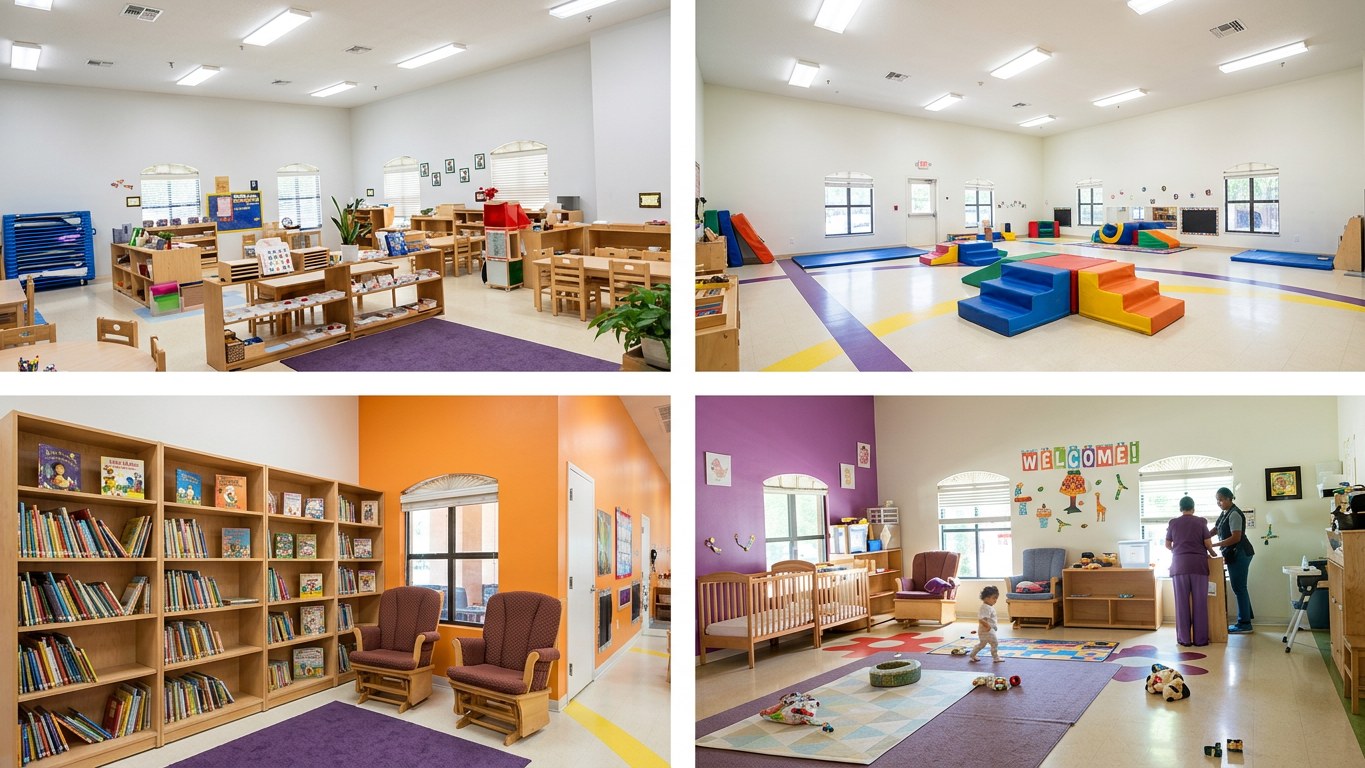
A good program does something for a burned-out parent that no technique can: it changes the arithmetic. It is shared care, which is the resource-side fix the research points to.
The mechanisms are concrete. Consistency between home and school makes family life more predictable and calmer — a child who knows what happens next is a child who fights less about it, and fewer daily battles means measurably less parental depletion. It's a virtuous cycle: their security makes it easier for you to stay regulated, and your regulation makes them more secure. Steady routines also prevent conflicts before they start rather than requiring you to win them. And trained observation gives you a second, calmer set of eyes — teachers watching your child all day can flag a pattern you're too depleted to notice (a sleep regression, a developmental leap, a new stressor) and, just as valuably, can say this is normal. For a parent whose burnout is fed by fear, "this is normal, we see it all the time" is a genuine intervention. Two-way engagement also correlates with better outcomes for the child across learning, behavior, and emotional well-being — so the partnership isn't only for your benefit.
A weak program makes it worse in specific ways. High staff turnover is the big one, and it's worth asking about directly: frequent caregiver changes disrupt continuity, can trigger real sadness and behavior changes in a child attached to a departed teacher, and mean the new staff don't know your child — which adds worry to a parent who has none to spare. Mismatched approaches cost you the consistency benefit entirely. And thin communication, or a center that brushes off a worried parent, deepens exactly the isolation and self-doubt that burnout runs on.
Run the communication three ways. You → the center: your child's triggers, what's happening at home (a new baby, a move, a stretch of bad sleep), and what you're trying so they can mirror it. And you're allowed to say that you are stretched thin — it's useful context for the adults spending six hours a day with your child. The center → you: regular two-way updates on what they actually observe — not just incidents but progress, patterns, and reassurance — and genuine interest in your input rather than a one-way newsletter. And the child, looped in: consistent goodbye rituals, a clear plan they can hold ("first school, then Papa picks you up"), and the same simple feelings language used in both places.
Worth asking any center: What's your staff retention like? How and how often will you tell me what you observe? Do you want my input on approach, or do you prefer to run your own? How consistent are the daily routines? A program that welcomes those questions will reduce your load. One that deflects them will add to it.
Escape Thoughts and Other Red Flags to Act On
This is not medical advice — if you're worried about yourself or your child, talk to your pediatrician, your doctor, or a licensed mental-health professional.
The most important red flags are escape and self-harm ideation. Parental burnout has been shown to increase both escape ideation — the fantasy of simply walking away from parenting — and suicidal ideation, and strikingly, these are more frequent in parental burnout than in job burnout or depression. Any thought of harming yourself, or that your family would be better off without you, means reaching out today rather than later. In the U.S., call or text 988 (Suicide & Crisis Lifeline), available 24/7. If you're in immediate danger, call 911.
Risk to the child, stated without judgment. Burnout has a documented circular relationship with neglect and harsh or violent parenting: burnout increases them, and they increase burnout. So emotional distancing from your child, harsh discipline, or yelling you can't seem to control are not evidence that you're a bad parent — they're evidence the situation has outrun what one depleted person can manage, and they mean the situation needs outside support now. Naming it to a professional is the protective act, not the shameful one.
When burnout overlaps with depression. Seek help if overwhelming feelings persist despite your own efforts, or if there's persistent anxiety or depression, sleep or appetite changes, loss of motivation, substance use to cope, or severe doubt in your parenting ability.
In the postpartum window, use the pediatrician. 15 to 20% of new mothers experience perinatal depression, and about half go undiagnosed and untreated. The AAP recommends screening once during pregnancy and at the 1-, 2-, 4-, and 6-month infant well-child visits — for a good structural reason: pediatricians see the mother-baby pair around eight times in the first year, far more often than the mother sees her own doctor. Your child's pediatrician is a completely legitimate place to raise your own mental health. Fathers experience postpartum depression too and should be identified as well. And why it matters beyond you: untreated parental depression is linked to impaired bonding and to toxic stress that can affect infant brain development, which means treating the parent is treating the child. The AAP's framing is worth repeating exactly — this happens to many new parents, you are not at fault, and it is treatable.
Other U.S. resources: the National Maternal Mental Health Hotline, 1-833-943-5746 (call or text, 24/7), and Postpartum Support International, 1-800-944-4773.
Every Family Is Different — Trust Yourself
There is no formula here, and notice which direction the research points: away from optimization. The antidote to burnout is dropping the cult of the perfect parent, not mastering it. That's an unusual finding — most advice tells you to do something better. This one tells you to do less, and means it.
The cultural data makes the same point from another angle. Burnout is higher in individualistic societies and lower in collectivist ones, which means "the right way to parent" is context-bound rather than universal. Your family's background, values, and available support shape what will actually work for you, and an approach that would fail in someone else's house may be exactly right in yours.
The one thing that is firmly evidence-based is also the most forgiving: your own regulation feeds your child's. A cared-for parent is the environment a child grows in. Which means taking care of yourself is not stolen from your child's account — it's a deposit into it. Self-compassion isn't indulgence; it activates the body's own soothing system and leaves you more resourced, not less.
So trust yourself. You know this particular child better than any expert on any screen. Take what fits your season and leave the rest without guilt. And keep the sentence that belongs to every parent reading this at the end of a hard day: you're not doing it wrong. It's just that hard. And it does not stay this hard.
Related struggles
- The invisible work driving most of this → The mental load of motherhood.
- The isolation underneath it → The lonely stay-at-home mom.
- Who you were before, and where she went → Losing yourself in motherhood.
- What burnout does to the couple → Marriage after baby.
- The guilt loop, in detail → Working-mom guilt.
- The number-one fuel → Baby won't sleep? Why it happens and what helps.
- The screen-time guilt cycle named above → Screen time for toddlers.
- The behavior that drains the tank fastest → How to handle toddler tantrums.
Sources: Mikolajczak, Gross & Roskam (the four dimensions of parental burnout, 2019) via Greater Good Magazine, UC Berkeley ("Six Ways to Deal With Parental Burnout" — Roskam, Divecha, Tottenham, Spalding; culture and burnout rates; HALT and STOP); Psychological Science / Association for Psychological Science and ScienceDaily (parental burnout's harmful outcomes — escape and suicidal ideation exceeding job burnout and depression; independence from depression); ScienceDirect, Mikolajczak et al. (burnout, neglect and violence — the circular link); BMC Public Health systematic review (demands-resources mechanism; risk factors including child-oriented perfectionism); Frontiers in Psychology (roughly 1 in 8 prevalence; intensive parenting); PMC, "Parental Burnout: When Exhausted Mothers Open Up" (fear, guilt, loss of self, robotic functioning); U.S. Surgeon General's 2024 advisory, "Parents Under Pressure," via HHS and the National League of Cities (48% and 41% figures; technology as a named stressor); Psychology Today, "Mental Load: The Invisible Weight of Parenthood" (71/29 split, the perception gap, executive-function load, redistribution strategies); Momwell (redistributing the mental load); Healthline (parental burnout and when to seek help); Care.com (working-mom burnout; cutting self-care first); AOL (the "touched out" account); ParentMap ("Mommy Wine Culture Isn't Cute or Funny"); Norland (alloparenting — a historical perspective); The Conversation ("Parents don't need to try harder — share the care"); PMC (social-media comparison and parental burnout); Taylor & Francis ("Too Much Screen Time or Too Much Guilt?"; parental burnout in LGBTQ+ parents and sexual-minority stress); Frontiers in Developmental Psychology (parent smartphone use, responsiveness and depressive symptoms); American Heart Association (protecting fathers' mental health) and Talkspace (fatherhood depression); AAP / HealthyChildren.org and AAP Voices (perinatal depression prevalence, screening at 1, 2, 4 and 6 months, effects on bonding and infant development); Teaching Strategies and Button Law Firm (teacher and daycare turnover); Kids USA Montessori (calm parenting and the prepared adult); Montessori Foundation and MHFC Schools (parent partnership and engagement). Crisis resources: 988 Suicide & Crisis Lifeline; National Maternal Mental Health Hotline 1-833-943-5746; Postpartum Support International 1-800-944-4773. Stories are drawn from real parents' experiences; names and identifying details have been changed for privacy.