


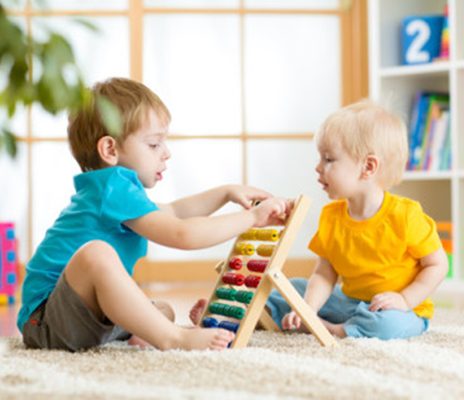
A child can recite numbers to twenty without understanding quantity, and memorize an answer without grasping the relationship that produced it. Early mathematics should cultivate quantitative thinking — comparing, patterning, estimating, dividing, reasoning — not just numerical recall. When a child splits six objects into two equal groups, the prize isn't the answer "three"; it's discovering that six can be organized that way. The goal is a child who naturally asks: How much? How are these related? Does this make sense? That is mathematical thinking, and it starts years before arithmetic.
Part 7 of 14 in The Whole-Child Series · Previous: Reading and Writing · Next: Emotional Development
Counting is not the same as understanding
Few party tricks delight relatives like a two-year-old counting to twenty. And it is delightful — rhythm, memory, and confidence all on display. But it's worth knowing what that recitation is and isn't. A child can recite numbers without necessarily understanding quantity, the way many of us can sing a verse of a song in a language we don't speak. The sounds are in order; the meaning isn't there yet.
Ask that same fluent counter to hand you three crackers and you may get a fistful, or one, or the whole box. Nothing is wrong — this is a completely normal snapshot of a mind mid-construction. The number words have arrived before the number sense. The work of early mathematics is closing that gap, and it cannot be closed by more recitation.
The same caution applies further up the ladder. A child can memorize an answer — "two plus two is four" — without understanding the relationship that produced it. Memorized answers look identical to understood ones on the surface, which is exactly why they're seductive. The difference only shows when the question changes shape. Understanding travels to new problems; memorization stays home.
In the previous article we saw that literacy is bigger than letters. Mathematics deserves precisely the same distinction: it is bigger than numbers.
What quantitative thinking actually looks like
Early mathematics should cultivate quantitative thinking, not simply numerical recall. And quantitative thinking, for a young child, is a wide and lively territory. Children can:
- Compare quantities — which basket has more pinecones, and how do you know?
- Identify patterns — red-blue-red-blue... and the deep satisfaction of announcing what must come next.
- Sort objects — by size, color, kind; sorting is classification, the ancestor of sets.
- Recognize shapes — not just naming a triangle, but noticing triangles hiding in rooftops and sandwiches.
- Estimate — "about how many steps to the gate?" builds the number sense that catches absurd answers later.
- Measure — how many hand-spans wide is the table? Measurement makes number useful.
- Sequence — first, second, third; smallest to largest; the order of the morning routine.
- Divide and combine — splitting the strawberries fairly, merging two block bins and discovering the pile grew.
- Reason about relationships — if you're four and your sister is six, she's two more; next year, still two more. Interesting!
Notice how little of that list involves numerals, and how much of it involves hands. That's no accident — as we explored in the article on concrete-to-abstract thinking, symbols only become meaningful when they name experiences a child has already had. Mathematics is the clearest case of the rule.
Six objects, two people, one big discovery
Consider a small scene that happens daily in classrooms and kitchens. Suppose a child has six objects — crackers, shells, toy cars — and is asked to divide them equally between two people.
Watch what actually happens. One for you, one for me. One for you, one for me. One for you, one for me. Piles get checked, recounted, evened. And then the moment: both piles hold three, and the child sees it.
The important learning is not merely that the answer is three. The child is discovering a relationship: six can be organized into two equal groups of three. That is a fact about the structure of six — and structure is what mathematics is actually about. The child who owns that discovery is standing at the trailhead of division, multiplication, fractions, and even algebra, all of which are elaborations of one idea: quantities have structure, and structure can be reasoned about.
A parent once told us, half-apologizing, that her daughter "wasn't doing math yet" — while the girl, four, stood at the counter splitting a pile of grapes between two bowls, moving one grape back and forth until the piles matched, frowning like a jeweler. She was doing math. It just didn't look like a worksheet, because real early math rarely does.
The questions that make a mathematical mind
Here is the honest framing of the goal, and it may take some pressure off your shoulders. The aim is not to create children who can perform increasingly difficult calculations as early as possible. Research on early numeracy consistently finds that flexible number sense — built through comparing, estimating, and reasoning with real quantities — predicts later achievement better than early procedural drill.
The aim is to develop children who naturally ask: How much? How many? How are these related? What pattern do I see? Does this make sense?
That last question — does this make sense? — may be the most valuable mathematical habit a person can own. It's what catches the misplaced decimal, the absurd estimate, the too-good deal. And it grows from years of math meaning something, so that a senseless answer feels wrong. A child raised on pure recall has no such alarm bell; every answer is just an answer.
At home you can try
- Make sharing rigorous. "Split these between you and your brother — make sure it's fair." Fair sharing is division with stakes.
- Estimate, then check. "How many spoons do you think are in the drawer? Let's count and see." Being close is celebrated; being curious is the point.
- Cook with real measuring. Half cups, doubled recipes, "we need two more eggs" — measurement and operations, warm from the oven.
- Play board games with dice. Counting moves connects quantity to action; wanting to win connects it to motivation.
- Ask "how do you know?" when your child states a quantity. The reasoning is the math; the answer is just its receipt.
None of this requires acceleration, apps, or flashcards — a theme we'll return to in Part 11 on acceleration versus development. It requires only that number stay attached to meaning while the child is small. Do that, and you're not preparing a child to survive math class. You're raising someone for whom quantity, pattern, and structure are familiar friends — which is a genuinely happy way to meet the subject.
Next in the series, we turn from the intellect to something that quietly powers all of it: how children learn to stay with a problem when it gets hard.
Keep reading
- Reading and Writing: Opening the Door to Ideas — the previous part: literacy as a tool for thinking, not a performance.
- Emotional Development: Learning to Stay With a Problem — next in the series: the persistence that powers every subject.
- From Concrete Experience to Abstract Thinking — why hands-on quantity comes before written numerals.
- Is My Child Ready for Kindergarten? — where number sense truly sits among readiness skills.
- Our Curriculum — how math materials move from beads in the hand to symbols on paper.
- Teaching Approaches, Researched — the evidence behind concrete-first mathematics.
If you'd ever like to watch four-year-olds build four-digit numbers out of golden beads — and grin about it — come see our classrooms; we'll save you a small chair.