



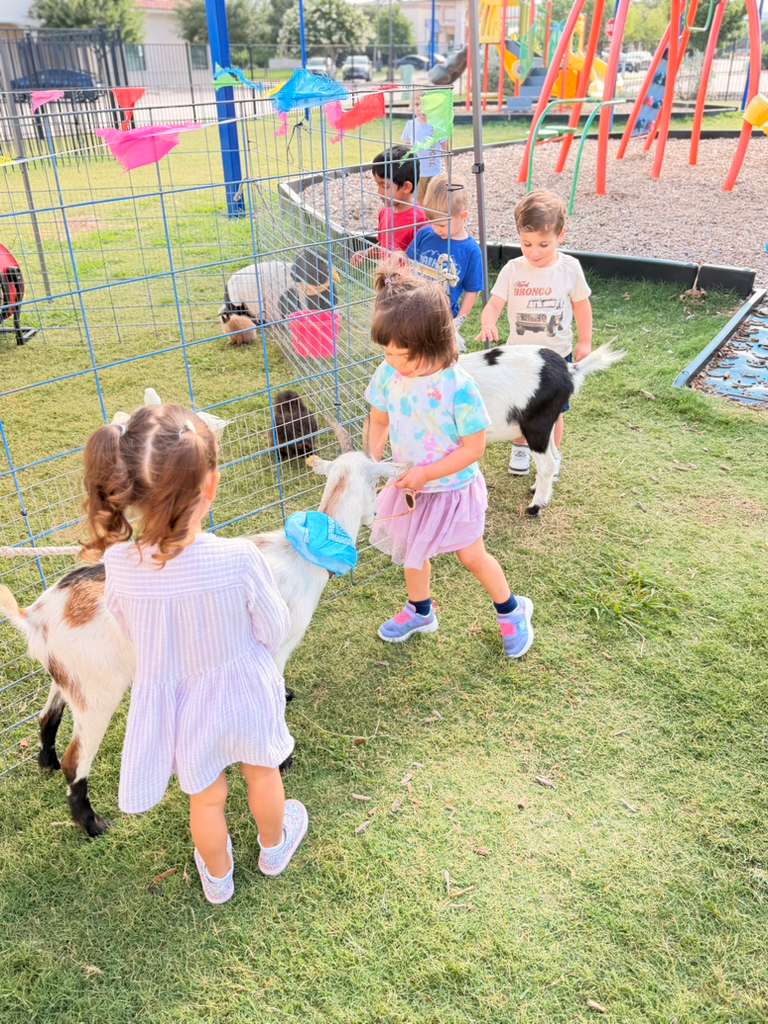
Hitting, biting, grabbing, and "not listening" are almost always normal for toddlers and preschoolers: a big feeling meeting a brain that hasn't grown the brakes or the words yet. Not meanness, and not bad parenting. Children under about three literally cannot share on demand or hold another person's perspective — real sharing skill usually shows up around 3.5 to 4 — and over half of young-toddler aggression comes from curiosity, testing, and attention-seeking rather than anger. What works: skip spanking and threats (they increase aggression), hold the safety limit calmly, name the feeling, teach the specific do-instead, and remove the triggers — with home and childcare using the same words. Call your pediatrician if it's escalating rather than fading, causing real injury, or persisting well beyond a few weeks of consistent effort. (Not medical advice.)
The problem, in real voices
A mother watched her toddler bite a friend over a plastic shovel at playgroup. She saw the teeth marks rising on the other child's arm, apologized to the visibly annoyed parent, and wanted the earth to open up. On the drive home she kept circling one question: is mine the bad kid?
A father told his daughter, softly and reasonably, not to throw the ball at the television. She looked him dead in the eye, smiled, and threw it. He stood there realizing he apparently held no authority whatsoever in his own home.
Another mother described a toddler who melted down over every little thing, several times a day, each one running twenty or thirty minutes. Her line is the one every parent recognizes: when her daughter is in that mood, it's like she forgets how to talk, and her ears stop working.
And a parent on the other side of it — whose child kept getting bitten at daycare — described feeling worried, frustrated, and a bit helpless, especially once her son started hesitating at the door in the morning and saying he got hurt there. She wanted to protect him without getting another two-year-old labeled for life.
Four families, one underlying story. Every one of these children understood the words perfectly and still could not deliver the behavior — because understanding a rule and having the brakes to follow it are two entirely different developmental achievements.
What's really going on underneath
The AAP frames it as plainly as it can be framed: young children have very little natural self-control. Hitting, biting, and grabbing are the default output when a big feeling meets an undeveloped brake. Using words instead is not innate — it's a skill that has to be taught, repeatedly, and it arrives late relative to the feelings it's meant to manage. That one sentence explains all four behaviors in this article: the gap between what a toddler wants and the tools they have to handle wanting it.
Biting is usually not aggression at all. The real drivers are teething pressure and oral-sensory need, hunger, tiredness, overstimulation in a loud room, frustration, fear, attention-seeking, plain cause-and-effect curiosity, and self-defense. Research on young-toddler aggression finds that over half of it stems from non-distress causes — exploring, testing what happens, getting a reaction — rather than anger. So the interpretation almost every parent reaches for first, he's being mean, is usually the wrong one.
Not sharing is a developmental fact, not a manners failure. Children under about three genuinely cannot hold another person's perspective, and they have no working concept of time — which is the part parents miss. If your two-year-old hands over the bucket, she cannot grasp that it comes back, so from inside, sharing isn't generosity, it's permanent loss. And she's mid-way through mastering ownership, which developmentally has to come before sharing does. The expectation gap is stark: 43% of parents surveyed thought children should have mastered sharing by age two, while actual sharing skill typically emerges around three and a half to four. A great deal of "my child won't share" is a calendar problem, not a child problem.
Not listening is autonomy on schedule. The maddening part — she clearly heard me — is real, and it isn't disrespect. A toddler mid-task, mid-feeling, or mid-experiment in being a separate person who gets to choose is doing the exact developmental work of the age. Add too many words or too many instructions at once and you get overload, which is precisely when the ears stop working.
All of this interlocks with the rest of toddler life: fewer words means more hitting; a short night or a late lunch shortens the fuse; and much of what looks like defiance is really an inability to switch tasks yet.
Toddlers Always Bit — Three Things Make It Feel Worse
Your grandmother's toddler bit people too. What changed is the response, not the behavior. For centuries, children were treated as small adults in need of constant correction — corporal punishment was considered not just acceptable but necessary, and open affection was widely believed to spoil a child. In 1946, Dr. Spock's Baby and Child Care swung mainstream advice toward reasonable, consistent, friendly parenting over regimented authority, a genuine cultural rupture that later got blamed for a generation of permissiveness. The modern paradigm reframes the whole thing again: hitting and tantrums are not misbehavior to be punished but feelings a child hasn't yet learned to regulate — born with all the feelings, none of the skills.
What makes it feel harder now isn't the biting. It's three modern amplifiers.
The first is screens, and specifically one use of them. Research suggests that using a screen to manage a child's emotions or behavior may hinder the development of self-regulation — the very capacity whose absence causes the hitting. Worse, the pattern appears to be a vicious circle: more screen time is linked to more emotional and behavioral problems, and children who are already dysregulated get handed more screens to cope, each feeding the other. Heavier toddler screen use has been associated with higher negative emotionality, greater emotional reactivity, more aggression, and lower soothability. Which is uncomfortable, because the screen is exactly what a cornered parent reaches for mid-meltdown.
The second is isolation. Previous generations had more adults in the room — the extended family absorbed some of the load and, crucially, normalized the behavior. A parent who has never watched anyone else's toddler bite someone concludes theirs is uniquely broken.
The third is performance parenting. Comparison culture turns a universal developmental stage into a public verdict on you, which is why the shame in that playgroup story is so disproportionate to a two-year-old and a plastic shovel.
Where technology genuinely helps: co-viewing good content, video calls with grandparents (the AAP explicitly exempts video chat from under-18-month limits), feelings-and-emotions picture books, and honestly, parent-education content like this. The problem is the solo-pacifier pattern, not the existence of the device. And one worth naming: your own phone competes for your attention, and a distracted parent reliably produces more attention-seeking hitting.
How parents usually try to fix it — and the catch
- Punishment and power moves — time-outs, threats, confiscation, raised voice, and in older-generation practice, spanking. (Toddler and preschool.) The upside: fast, it restores the adult's sense of control, and it does often stop the immediate act. The catch: the AAP is unusually direct here — spanking and harsh, coercive discipline increase aggression and anger over time and teach nothing about self-control. And children under three don't understand punishment as a concept at all, which means it cannot teach them even in principle. Threats have a subtler failure: "stop it or else" contains zero information about what to do instead. Plenty of parents know this from the inside; one described being stuck in the stage where nothing works unless he threatens, hating himself for playing the do-what-I-say card, and doing it again the next day.
- Give them an outlet — a pillow to hit, a teether to bite, a quick redirect. (Toddler.) The upside: a genuine release valve, it respects the sensory need, and it works as in-the-moment de-escalation. The catch: handing a child something to hit can reinforce hitting for some children — the object changes, the motor habit strengthens. And redirecting away from a distressed child skips the teaching step entirely. This is a bridge, not a strategy.
- Force the sharing, script the apology — hand it over, say sorry, share on the count of three. (Toddler and preschool.) The upside: peace arrives quickly, it models the social expectation, and it satisfies the watching adults, which is not nothing when you're the parent being judged. The catch: forcing a child under three to share fights their actual developmental stage — no perspective-taking, no sense of time — so it breeds resentment and more grabbing, and a coerced "sorry" carries no meaning for anyone. Security has to come before generosity.
And the modern, well-meaning one that backfires: "gentle parenting" that drifts into permissiveness — endless negotiation, no firm limit, never a plain no. (Toddler and preschool.) The upside: it's warm, validating, protective of the relationship, and free of fear-based discipline, all of which are real goods. The catch: warmth without structure tends to produce more anxious, less resilient children and thoroughly exhausted parents. The distinction matters, so let's be precise rather than lazy about it: actual gentle parenting is warmth plus firm, respectful limits. Permissiveness is warmth minus limits. The drift is the problem, not the philosophy.
How two parents often experience it differently
Tendencies, not rules — and the mapping to gender is loosening fast, so read this as two stances that can live in any two adults, or in one adult on different days.
One caregiver tends to take the behavior personally and protect the bond: why is he doing this to me? That stance pulls toward immediate, power-assertive correction, because the hit landed emotionally. The other tends to frame it around long-term outcomes — he needs to learn this or the world will go badly for him — and stays more matter-of-fact. Historically this was mapped onto mother and father, but modern caregiving shifts mean the old pattern often doesn't hold, and the research itself is limited and evolving. One frequently-cited nuance, offered as a finding rather than destiny: harsher maternal discipline correlates more strongly with a child's emotion regulation and mood, harsher paternal discipline more strongly with the child's aggression — and a father's rough-and-tumble, physical, humor-heavy play style is thought to help teach emotional self-control precisely around aggression. A 2006 study found that combined parenting mattered more than either parent's style alone, which is the honest headline.
The clash is familiar: the firmer adult sees a pushover creating a monster; the warmer one sees someone frightening. And the child, who is a superb political operator by age three, learns to route every request to the softer parent. That splitting is worse for a toddler than either style would be on its own, because it turns every limit into a question of which adult is standing closer.
Turning it into teamwork takes four moves. Agree the non-negotiables in advance — no hitting, no biting, safety items only — so the child meets one wall rather than two doors. Let each stance cover the other's gap: the playful adult takes the rough-and-tumble energy discharge, the structured one holds the routine and the bedtime. Never undercut each other in front of the child; disagree later and privately. And single parents, who carry both stances alone, should deliberately borrow the missing lens — a scheduled calm check-in with yourself, a co-parent, or a trusted friend, so that not every correction gets made in the heat of the moment. The same applies to grandparents and sitters, who need the actual script rather than a general sense that you're "working on hitting."
Better ways that actually work — introduced gently
Across all three: stop the behavior, name the feeling, teach the replacement, and remove the trigger next time. Punishment addresses the last two seconds; these address the next six months.
1. "Gentle hands, safe bodies" — and always name the do-instead
The mechanism is straightforward and the most underused principle in toddler discipline: a child cannot substitute a behavior they don't have. "No hitting" tells a two-year-old what to stop, and nothing whatsoever about what to do with the feeling that's still in their body — so the feeling comes out the same way it did last time. The Montessori version adds the crucial timing detail: the skill gets rehearsed in calm moments, not built from scratch mid-crisis.
The sequence in the moment: stop the act immediately, physically and unemotionally. Use minimal words with a flat, warm voice — "I won't let you bite. Biting hurts." Name the feeling, because a named feeling is a manageable one: "You're mad he took the truck." Then give the do: "You can say stop, or come get me." And then practice it right there, guiding the hand into a gentle touch, so the body learns the alternative and not just the ear. Outside of conflict, run twenty-second rehearsals daily — "show me gentle hands on the cat" — as a game rather than a lesson. For a young toddler, expect to be the physical brake for months while the words come online; a preschooler can start naming the feeling before the hand moves, and can help you decide the replacement in advance. Introduce it during calm play, never as a mid-crisis announcement, and keep the crisis script word-for-word identical every time — the predictability is itself soothing. Give it weeks, not days, and count reductions in intensity as progress. The saboteur is escalating your own volume when it doesn't work by Thursday; a loud adult teaches that big feelings are handled by getting louder, which is the lesson you're trying to reverse.
2. Turns and timers instead of forced sharing
This one works because it stops fighting biology. A child under three has no perspective-taking and no time concept, so the fix isn't more moral instruction — it's giving them security first and a neutral rule-keeper second. A timer does something a parent cannot: it takes sides without taking sides. The beep is the authority, not you, which removes the entire relational drama from the handover.
In practice: block the grabbing calmly and physically first, because safety precedes teaching. Then narrate to slow the moment down — "you both want the red cup" — and validate both children, out loud, in front of each other. Set a visible or audible timer for a generous turn: "when it beeps, it's her turn." Long turns matter more than fair ones, because a child who feels done releases the toy far more easily than one who was interrupted. Once everyone is calm, teach the two scripts that do the heavy lifting for years: "Can I have it when you're done?" and "You can ask first." For the youngest toddlers, don't ask for sharing at all yet — use duplicate toys and long turns, and let ownership finish forming. Preschoolers can brainstorm the solution with you rather than receive it, which is where genuine sharing actually begins. Introduce the timer on low-stakes items during a calm afternoon so it arrives as a fun ritual instead of a verdict. Expect real sharing to consolidate around three and a half to four — you are pre-building a skill, not enforcing one. The saboteur is overriding your own timer because another adult is watching and you're embarrassed; one override teaches that the beep is negotiable, and you'll spend a month rebuilding it.
3. Connect-then-redirect — and prevent the trigger entirely
Most aggression is a state, not a decision: tired, hungry, overstimulated, under-attended, or under-moved. That means the highest-yield intervention happens hours before the incident, in the environment, where no correction is needed at all. This is the Montessori observation loop — watch for the pattern, then change the conditions — combined with the positive-discipline finding that catching and naming the desired behavior outperforms punishing the unwanted one.
Start by tracking triggers for a few days, written down: what time, what room, what preceded it. Patterns surface fast and they're almost always boring — before lunch, the last hour before pickup, the crowded corner by the block shelf, any wait longer than a minute. Then pre-empt: feed and rest before the known danger window, get outdoor time in, and build in "heavy work" — carrying, pushing, hauling the watering can — which discharges the physical load that turns into hitting. Duplicate the two most-fought-over toys. Shorten the waits. In the moment itself, connect before you correct: get down low, calm voice, name the feeling, then redirect to something acceptable. And be loudly specific about the wins — "you asked for a turn instead of grabbing, that was so grown-up" — because a child who gets attention for the good behavior needs the hit less. Reserve time-outs as a genuine last resort. For toddlers, prevention does most of the work; for preschoolers, you can start including them in it ("what would help at pickup time?"). Introduce it invisibly — a trigger you quietly removed is a correction the child never had to receive. The saboteur is only ever showing up at the incident: if all your attention arrives when the hand does, you've accidentally made hitting the most reliable way to reach you.
From the child's side
Your child is not scheming. From inside, it's closer to: I want it now, I have no words fast enough, and my body did the thing before I arrived. The feeling shows up fully formed. The brake and the vocabulary are still under construction.
For the biter, it's often even less dramatic than that — teething pressure that needs somewhere to go, a nervous system overwhelmed by a loud room, or pure cause-and-effect fascination: I did a thing and something enormous happened. Some bites are straightforwardly sensory-seeking. Almost none of them are I want to cause pain, because that requires a theory of another person's inner life that a two-year-old does not yet have.
For the child who won't share, handing over the toy feels like losing it forever, and the toy is mine in a brand-new, thrilling, recently-discovered way. Being forced to give it up doesn't read as a lesson in kindness. It reads as a theft that the adults organized.
For the child who won't listen, they heard you — and they're mid-task, or mid-feeling, or actively testing whether they're a separate person who gets to choose. That test is the developmental job of the age, and passing it is how a self gets built.
And for the child on the receiving end — the one who got bitten — there's fear, confusion, and sometimes real reluctance to go back into the room. That child needs two specific things: reassurance that it wasn't their fault, and the words to say stop.
What every one of them needs under the behavior is the same short list: to be understood (feeling named), kept safe (a firm limit is safety, not rejection), handed the missing tool (the word, the script, the gentle hand), and helped with the physical state (food, rest, movement). The behavior is a signal about an unmet need, not evidence of a character flaw.
When Home and Daycare Say the Same Words
This is the topic where consistency between home and childcare pays off fastest, and where a good program can see things you structurally cannot. Trained staff watch for the pattern across a whole day in a peer group — that the biting clusters at 11:40, that it happens in the narrow space by the shelf, that it follows the third time a child was told to wait — and then change the environment rather than the child: shorter waits, duplicated materials, more movement, better spacing. They also practice the social scripts daily, in calm moments, as a curriculum rather than a correction; in Montessori settings this is "grace and courtesy," and educators using it report conflicts decreasing and children spontaneously using the polite scripts with each other. Mixed-age rooms help too, because a two-year-old learns gentleness fastest by watching a four-year-old do it. And a good center communicates after every incident — to both families, the biter's and the bitten child's — covering what happened, the immediate safety response, the prevention plan, and the replacement skill being taught.
A weak program makes it measurably worse. Communication is thin or defensive: you find out days later, or in a one-line hand-off at the door, or not at all, and there's no written behavior policy to point to. The approach is mismatched — the center shames or punishes while you're connecting and teaching, so the child gets whiplash and the whole thing takes twice as long. Staff turnover breaks the trusted-adult bond the method depends on. Or concerns get waved away as "they all do it," which is true and also not a plan.
Run the communication three ways. You → the center: the known triggers (fading by four, hates transitions, currently teething), the exact words you use at home so they can match them syllable for syllable, and any recent change — new sibling, bad sleep week, a move. The center → you: what they observe day to day, what preceded each incident, the safety response used, the prevention plan, and honest reports on the good days too, not only the bad ones. And the child, looped in: the same simple language in both places, a feelings chart or calm corner they recognize in each building, and the explicit knowledge that the adults are one team — "Ms. Ana and I both know you're working on gentle hands." What to ask any program: Can I see your written behavior and biting policy? How do you handle an incident, and how will you tell me? How do you supervise the high-risk times of day? How long has this room's staff been together? Specific, unembarrassed answers are the green flag — and if you're the parent of the child who got bitten, ask for a real meeting rather than a pickup-line conversation. You are entitled to the prevention plan, not just the incident report.
When Aggression Escalates Instead of Fading
This is not medical advice — when in doubt, talk to your pediatrician. The vast majority of hitting, biting, grabbing, and not-listening at this age is normal and time-limited. Hitting and biting typically decrease through the late second year as language arrives. Red flags are about pattern, intensity, injury, and trajectory — not one terrible Tuesday.
Worth a conversation with your pediatrician, or a referral to a child psychologist, if: the aggression persists beyond a few weeks despite calm, consistent intervention; it's escalating over time rather than fading; the child is causing real injury — deep bites, bruises, head injuries — or attacking adults; the child is being excluded from or removed from care or peer groups; serious outbursts are frequent (roughly monthly or more) and the child cannot be soothed at all during them; or the aggression comes with other changes — sleep or appetite shifts, withdrawal, excessive crying, new hyperactivity or trouble concentrating, or loss of skills the child previously had. Any sign that a child is being exposed to abuse, or is watching aggression modeled somewhere, warrants a prompt conversation.
And one more, said plainly because it gets left out of these lists: if you can't respond calmly — if you're frightened by your own anger or tempted toward physical punishment — that is also a completely valid reason to ask for help. Getting support for the adult is a legitimate intervention for the child.
Every Family Is Different — Trust Yourself
No single method fits every child, because temperament is real: some children are simply more reactive and less soothable than others, and the same script that works beautifully on one sibling will bounce off the next. The research itself is limited and still evolving — see how carefully the mother-father findings have to be hedged — so anyone selling you one guaranteed answer is overselling.
Culture belongs in this conversation too. What counts as listening, how much firmness is respectful, and what sharing norms apply in a family vary enormously by background and values. Honor your own family's version instead of importing one internet style wholesale.
So take the principles and adapt them: keep everyone safe, teach the alternative, connect before you correct, prevent the triggers, and stay boringly consistent. You are the expert on this particular child. And the most reassuring thing in the evidence is also the most forgiving: a warm, calm, consistent parent who gets it wrong sometimes beats a perfect script delivered anxiously. The toddler who bit someone at playgroup today is not a bad kid, and you are not a bad parent. You're both partway through a skill neither of you is finished teaching.
Related struggles
- The same regulation gap, at full volume → How to handle toddler tantrums.
- Holding the limit without punishment → Gentle discipline that works.
- Fewer words means more hitting — the language half of this → Is my child's development normal?.
- The vicious circle named above → Screen time for toddlers.
- Turn-taking at home, with a rival in the house → Sibling rivalry solutions.
- Tired and hungry are the two biggest triggers → Baby won't sleep? Why it happens and what helps.
- Books that give feelings a name before the hand moves → our best books for preschoolers, and how different approaches teach social skills → early childhood education methodologies.
Sources: HealthyChildren.org / AAP (10 tips to prevent aggressive behavior; discipline guidance; corporal-punishment policy update); AAP News (positive discipline rather than physical or verbal punishment); Medical News Today (toddler hitting — causes, non-distress aggression share, red flags, AAP screen guidance); ZERO TO THREE (helping young children with sharing — perspective-taking, time concept, the 43% expectation gap); First Things First and Happiest Baby (when sharing actually emerges); MSU Extension (why toddlers bite; caring for a toddler who bites); Montessori 4 Teachers (age-by-age approaches to biting, hitting and rough play; observation and prevention; timers and duplicate materials); Austin Children's Academy (conflict resolution and grace-and-courtesy outcomes in Montessori classrooms); Fatherly (how child discipline has changed; mother/father discipline differences and their caveats); APA (screen time and emotional problems — the vicious circle); Pediatric Research / Nature (preschooler screen time and temperamental anger); Frontiers (parental digital emotion regulation and children's self-regulation); The Natural Parent Magazine and Newsweek (permissiveness vs. gentle parenting); A Child's Touch (when your child keeps getting bitten); ChildCarePath (daycare biting and challenging-behavior parent guidance). Stories are drawn from real parents' experiences; names and identifying details have been changed for privacy.