



Whole-child development is often described as four areas — cognitive, physical, emotional, and social — but that picture is incomplete. The deeper idea is that these dimensions are interconnected: one simple activity can grow all of them at once. A child pouring water is coordinating hand and eye, judging quantity, recovering from spills, waiting for a turn, caring for the environment — and, most importantly, discovering "I can do something for myself." The goal of a whole-child program is an environment where every kind of development reinforces the others, not a checklist worked through box by box.
Part 2 of 14 in The Whole-Child Series · Previous: The Whole-Child Approach · Next: Practical Life
Four boxes on a report card
Ask what "whole-child education" means and you will usually hear a list: it develops the child cognitively, physically, emotionally, and socially. You may have seen those four words arranged in tidy quadrants on a program's website, each with its own icon.
That description is useful. It is also incomplete — and the incomplete version quietly shapes how many programs are built. If development comes in four boxes, then education becomes a scheduling problem: circle time for the cognitive box, playground for the physical box, a feelings chart for the emotional box, sharing practice for the social box. Fill each box, and the child is presumably whole.
But children do not develop in boxes, and in Part 1 of this series we saw why: young children grow as integrated people. The deeper idea behind whole-child education is that these dimensions are interconnected — so tightly interconnected that a single, well-chosen activity can nourish all of them at the same time.
The four boxes aren't wrong. They're just walls drawn through the middle of something that has no walls.
One pitcher of water, six kinds of growth
Consider a young child learning to pour water from one small pitcher into another — an activity you will find on a low shelf in Montessori classrooms everywhere, ours included. It looks almost comically simple. Watch closely, though, and count what is actually happening.
Physically, the child is coordinating hands and eyes, controlling the tilt of the wrist, steadying the pitcher's weight as it shifts with every ounce that leaves it. This is precision work for a three-year-old, the same fine-motor control that will later hold a pencil.
Cognitively, the child is judging quantity, position, and cause and effect. How full is too full? How fast is too fast? Tip the pitcher this much, and the water arrives there. Every pour is a small experiment with immediate, honest feedback.
Emotionally, the child may spill — and here is where the activity earns its keep. There is a flash of frustration, a wobble, and then a cloth within reach and a way to make it right. The child learns to recover from a mistake, not merely to avoid one.
Socially, there is one pouring tray and there are many children. Someone waits. Someone finishes and resets the tray so it is ready for the next person — a quiet act of consideration that no worksheet can teach.
Practically, the child is learning to care for the environment: wiping the table, returning the tray, leaving the work inviting for whoever comes next.
And psychologically, something even more important may be happening. The child is discovering, "I can do something for myself." That sentence, repeated across a hundred small victories, becomes the bedrock of confidence — the real thing, earned rather than praised into existence.
Why interconnection changes how classrooms work
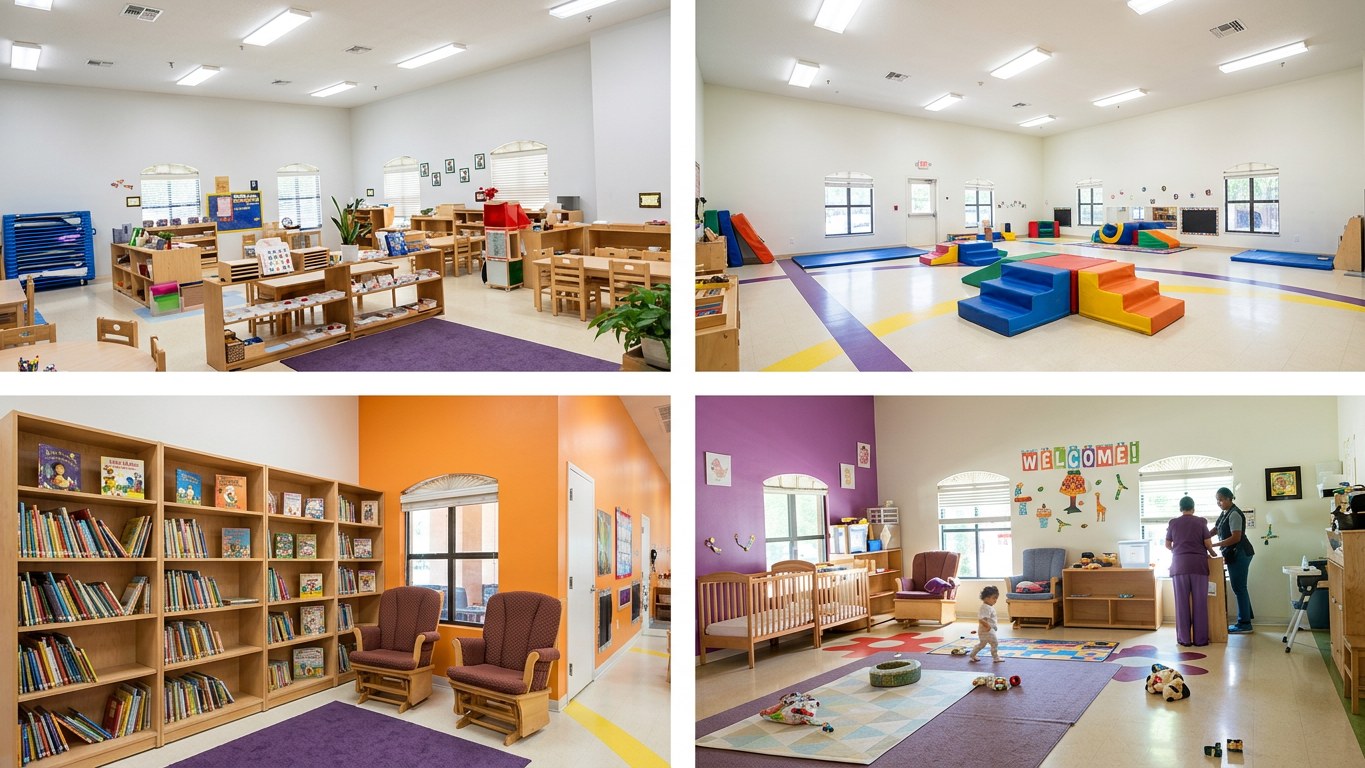
Once you see development as a wheel rather than a checklist, the design of a classroom changes. A whole-child approach is not a schedule that rotates children through four stations. The objective is to create an environment in which every form of development reinforces the others — where the same experience deposits into several accounts simultaneously.
It also changes what teachers watch for. When a child struggles with a "cognitive" task, the cause is often somewhere else on the wheel. The child who can't attend to the sound game may be a child who hasn't yet burned off the morning's need to move. The child who dissolves over a puzzle may need emotional tools before puzzle tools. A checklist mindset drills the weak skill; a whole-child mindset looks around the wheel and asks what the skill is resting on. If you've ever wondered why a tantrum can evaporate after twenty minutes of hard outdoor play, you've seen the wheel turning.
One of our teachers likes to tell parents about a boy who spent weeks doing little but scrubbing tables — "just" practical work, a worried parent might say. Then one morning he sat down with the metal insets and drew for forty minutes with the same two-handed steadiness he'd built at the scrubbing table. "He wasn't avoiding writing," she says. "He was getting ready for it. His hands knew before we did."
What this looks like at home
You do not need a classroom to put interconnection to work. You need ordinary life, offered a little more slowly.
- Pick one real task and hand it over whole. Watering the plants, feeding the cat, setting out napkins for dinner. Resist the urge to split it into "the easy part." The wholeness is the point.
- Let the mistake stay fixable. Keep a small towel where your child can reach it. A spill they can wipe up themselves teaches recovery; a spill an adult whisks away teaches only that mistakes summon adults.
- Narrate relationships, not just facts. "The pitcher is heavier when it's full" does more for a young mind than "be careful."
- Watch for the wheel. When a skill stalls, ask what's underneath it — tired body, big feelings, missing words — before you drill the skill itself.
These small moments are exactly where the next article in this series begins, because the richest source of wheel-turning activities in early childhood is the category Montessori educators call Practical Life — the ordinary work of caring for oneself and one's surroundings. What looks like chores turns out to be curriculum.
Keep reading
- The Whole-Child Approach — Part 1: the series overview, and why capability beats acceleration.
- Practical Life: Why Independence Begins With Ordinary Things — Part 3: brooms, buttons, and the birth of confidence.
- How to Handle Toddler Tantrums — the emotional spoke of the wheel, in its stormiest form.
- Gentle Discipline That Works — guidance that builds self-regulation instead of just compliance.
- The Montessori Advantage — how our classrooms are built around interconnected development.
The wheel is easier to see in person than on a page — five minutes watching a child at the pouring table says more than any diagram. We'd love to have you visit and watch a morning unfold.