


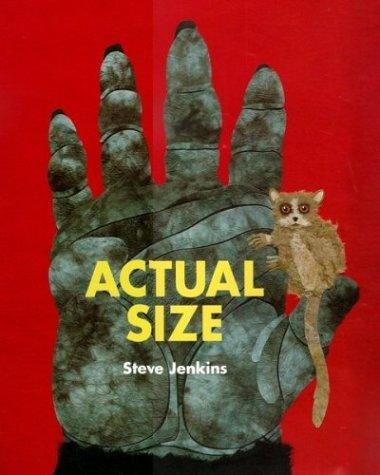
Actual Size
A teacher’s look at why this book belongs in the The Why-Askers stage.
Why it fits The Why-Askers (for preschoolers whose every page sparks a question)
Animal parts printed at true scale: a gorilla's hand, a giant squid's eye. Children measure themselves against the pages bodily, which is how they think. Makes 'how big?' a question with a touchable answer.
What makes it special
The concept is irresistible: everything printed at true scale, so a child's hand measures against a gorilla's. Jenkins' cut-paper collages have a tactile, museum-diorama realism that makes the comparisons visceral. No screen can do this — a phone showing a gorilla hand is phone-sized, and children grasp that difference immediately.
From the publisher
Discusses and gives examples of the size and weight of various animals and parts of…
About Steve Jenkins
Steve Jenkins (1952–2021) made cut-paper collage so precise it reads as scientific illustration; his Caldecott Honor book What Do You Do with a Tail Like This? and dozens more brought real zoology to picture-book shelves.
The son of a physicist, Jenkins planned on science before art school claimed him — and then spent his career fusing the two, building every animal from hand-torn paper with data-checked accuracy.
Also by this author: What Do You Do with a Tail Like This? · Biggest, Strongest, Fastest · Down, Down, Down
More from “How the World Works”

This book is part of The Best Books for Preschoolers: 30 Teacher Picks (The Why-Askers) in our guide The Best Children’s Books by Age — 120 books chosen by the Montessori-certified teachers at Creative Minds Montessori in Frisco, TX. Come see how we build readers →
Nobody paid for this review — not the author, not the publisher — and the store link above earns us nothing. Our only interest is the reader this book fits.