



Two well-run West Frisco schools with different shapes. Primrose School of Lakehill is a franchise of a national system: the proprietary Balanced Learning® curriculum, a chef-run kitchen, care from infancy through a private kindergarten plus after-school and summer programs for children up to 12, weekly tuition posted on its website, and an owner-director who has run this campus since 2013. Creative Minds Montessori is a single independent school: certified Montessori guides, mixed-age classrooms, a Waldorf-inspired arts thread, organic milk and vegetables with no added sugar, no screens under two, all-day parent cameras, and infant teachers who have been here since the school opened more than ten years ago. Both hold Full Permits with no penalties and no enforcement actions on their five-year Texas records. Primrose has the cleaner deficiency count (9 vs. our 26, each over roughly 3,700–3,900 standards checked) and one serious injury on its record, which it reported itself; Creative Minds has zero injuries and fewer staff departures (5 and 7 in 2025 and 2024 vs. 11 and 13). Google rates Primrose Lakehill 4.8 stars across 50 reviews and Creative Minds 4.7 across 44. The right choice depends on whether you want a long, structured, all-ages campus with a printed price list, or a small Montessori school that ends at kindergarten and lets you watch the classroom all day.
Two schools, one neighborhood
If you live in West Frisco, both of these schools are probably already on your list. Primrose School of Lakehill sits at 5349 Lakehill Blvd, Frisco, TX 75034, off Warren Parkway near The Star and Hall Office Park. Creative Minds Montessori is at 5115 Warren Parkway, behind Dua Trattoria at the Legacy Drive and Warren Parkway intersection, also 75034. They are on the same stretch of Warren Parkway, close enough that you can walk both in one morning if you time the tours.
What makes this comparison worth reading is that the two schools have taken different bets about what young children need. One is a systematized campus with a national curriculum and a menu of programs that can keep a family from twelve weeks through summer camp at age twelve. The other is a small, independent Montessori school that stops at kindergarten entry and pours everything into the years before it. Neither bet is wrong. The point of this guide is to make the differences concrete enough that you can tell which one is right for your child.
At a glance
| Primrose School of Lakehill | Creative Minds Montessori | |
|---|---|---|
| Address | 5349 Lakehill Blvd, Frisco, TX 75034-6631 | 5115 Warren Parkway, Frisco, TX 75034-6289 (behind Dua Trattoria, Legacy Dr & Warren Pkwy) |
| Phone | (972) 210-0790 | (972) 338-4304 |
| Ownership | Franchise of Primrose Schools®, a national system of accredited private preschools; owned since 2013 by Christine and Mike Edwards, who work in the school daily | Single independent school, open more than ten years |
| Leadership | Christine Edwards, Administrator/Director on the Texas HHS record (in early childhood since 2002, a former Primrose director); Ms. Liz, Director, with Primrose since 2003 and at Lakehill since 2013; a Director of Education; a second director on the state record | Dinna Bacordo, Director; meet the team on our Our Team page |
| Hours | 6:30 AM – 6:00 PM, Mon–Fri per the school's website and Google listing (the state record lists permitted hours of 7:00 AM – 6:00 PM; ask which applies) | 7:00 AM – 5:30 PM, Mon–Fri (up to 10 hours of care; arrive by 9:00 AM) |
| Ages served | Infants through private kindergarten; after-school and summer programs for ages 5–12 | 6 weeks through kindergarten entry (Pre-K II / Transitional Kindergarten) |
| Texas state license | Licensed Center – Child Care Program, Full Permit issued July 18, 2019, renewal due July 2027; Texas HHS Operation No. 1692989, Denton County; marked Accredited on the state record | Licensed Center – Child Care Program, Full Permit since April 21, 2016; Texas HHS Operation No. 1597616 (listed as "Creative Minds"), Denton County |
| Accreditation / quality rating | Cognia certified (school's website); no Texas Rising Star level shown on the state record | Texas Rising Star Entry Level (the base certification tier) |
| Licensed capacity | 176 children (state record) | 226 children (state record); classrooms kept small by design |
| Schedules on the state record | Part-time care and after-school care listed; field trips; meals and snacks provided | Full-day programs; field trips with parent volunteers; meals and snacks provided |
| Educational approach | Primrose Balanced Learning®: teacher-guided instruction balanced with purposeful play in whole-group, small-group and individual settings; the "Active Minds, Healthy Bodies, and Happy Hearts®" framework | Montessori: prepared environment, self-chosen work, mixed-age rooms, five areas (practical life, sensorial, language, math, cultural) with a Waldorf-inspired arts, music, and nature thread |
| Classrooms | Infant, Toddler, Early Preschool, Preschool Pathways, Preschool, Pre-Kindergarten, Kindergarten, After School (Explorers), Summer Adventure Club | Nido (infant), Pre Casa (toddler), Transition, 3s, Casa (3–6), Pre-K I, Pre-K II / TK |
| Meals | Breakfast, lunch and snacks included, prepared on site by the school's chef (a former Frisco ISD nutrition-department employee, per the staff page) | Breakfast, lunch, and two snacks; lunch catered by KidzCaters on a four-week rotation; organic milk and organic vegetables, no added raw sugar, vegetarian option daily; nut-free |
| Classroom cameras | Not mentioned on the school's website; daily updates and photos come through the Procare app | Secure login to your child's room throughout the day; grandparents can get their own login; $25 per child per month |
| Screens | Not addressed on the school's website; the Primrose system's coding enrichment is described as screen-free | No screen time under age two; at most one supplemental, education-aligned hour for older children, never at meals or rest |
| Beyond preschool | Private kindergarten; Explorers after-school program and Summer Adventure Club for ages 5–12 | Not offered; the program ends at kindergarten entry |
| Uniforms | Required in Pre-Kindergarten, Transitional Kindergarten and Kindergarten | Not required |
| Tuition transparency | Weekly ranges by classroom posted on the website (see the cost section below); billed weekly or monthly; a limited number of hardship scholarships | Rates from the Director; $200 annual registration, $150 supply fee twice a year, sibling discount, $250 referral credit, $100/month welcome credit for 10 months |
| Google rating | 4.8 stars (50 reviews) | 4.7 stars (44 reviews) — see our Testimonials page |
Sources: each school's website and Texas HHS record, September 17, 2026; Google ratings and review counts as of the same date. Details change — confirm on your tour.
What kind of school each one is
Primrose School of Lakehill: a national curriculum with hands-on owners
Primrose Schools® describes itself as a national system of accredited private preschools serving infants through kindergarten, with before-and-after-school care. Every Primrose school is independently owned and operated, and the Lakehill campus has belonged to the same couple since 2013. Christine Edwards began as a preschool teacher in 2002 and directed a Primrose school before buying this one; her husband Mike joined full time in 2020 after a career in retail management. Their website says six of their own grandchildren have attended the school, which is the kind of detail that tells you the owners are not absentee.
The campus runs on the Primrose Balanced Learning® approach, a proprietary curriculum the company describes as a "research-informed" sequence of daily classroom experiences that balance teacher-guided instruction with purposeful play. Each classroom page on the Lakehill site is organized around the same three headings: Active Minds (language and literacy, science and engineering, math, social studies), Healthy Bodies (a physical-development strand called Thumbs Up! and a nutrition strand called Balanced Menus), and Happy Hearts (character development, social skills, and a creative-arts strand called Early Art Masters). Pre-K is taught "within large-group, small-group and independent settings," and the school says it uses a Balanced Assessment approach combining developmental screeners, nationally normed academic measures and observation. The Primrose system reports that 96 percent of its Pre-K students met ASQ benchmarks for problem solving; that is a system-wide figure from the company, not a Lakehill number.
The program is built to keep a family for a long time. Classrooms run from Infant through a private Kindergarten (uniforms required from Pre-K up), then continue with an after-school program called Explorers and a Summer Adventure Club for children five to twelve. The Primrose system also offers a rotating set of enrichment programs for ages three to six, each a three-month unit taught twice a week for 20 to 30 minutes and included in tuition at participating schools: Zoology with Benjamin®, Coding with Megy® (screen-free), Chess with Percy®, Drama with Og®, Piano with Billy®, Cooking with Molly, Little Magicians and Mindful Movement. Optional vendor activities such as Soccer Shots® and Tippi Toes® dance are offered at select schools for an extra fee. The Lakehill site does not list which of these it runs, so ask on your tour.
Two more things stand out on the Lakehill pages. The first is the kitchen: the school employs its own chef, who previously worked for the Frisco ISD nutrition department, and breakfast, lunch and snacks are included. The second is the staff page, which is unusually candid about tenure. It lists a lead infant teacher who has been at Lakehill since 2002, a support teacher and the Director since 2013, a Director of Education with Primrose since 2010, and the chef since 2017. It also shows that twelve of the seventeen staff profiled joined in 2022 or later, which is normal for the industry but worth knowing when you ask who will be in your child's room.

Creative Minds Montessori: one school, one philosophy, ten-plus years of the same faces
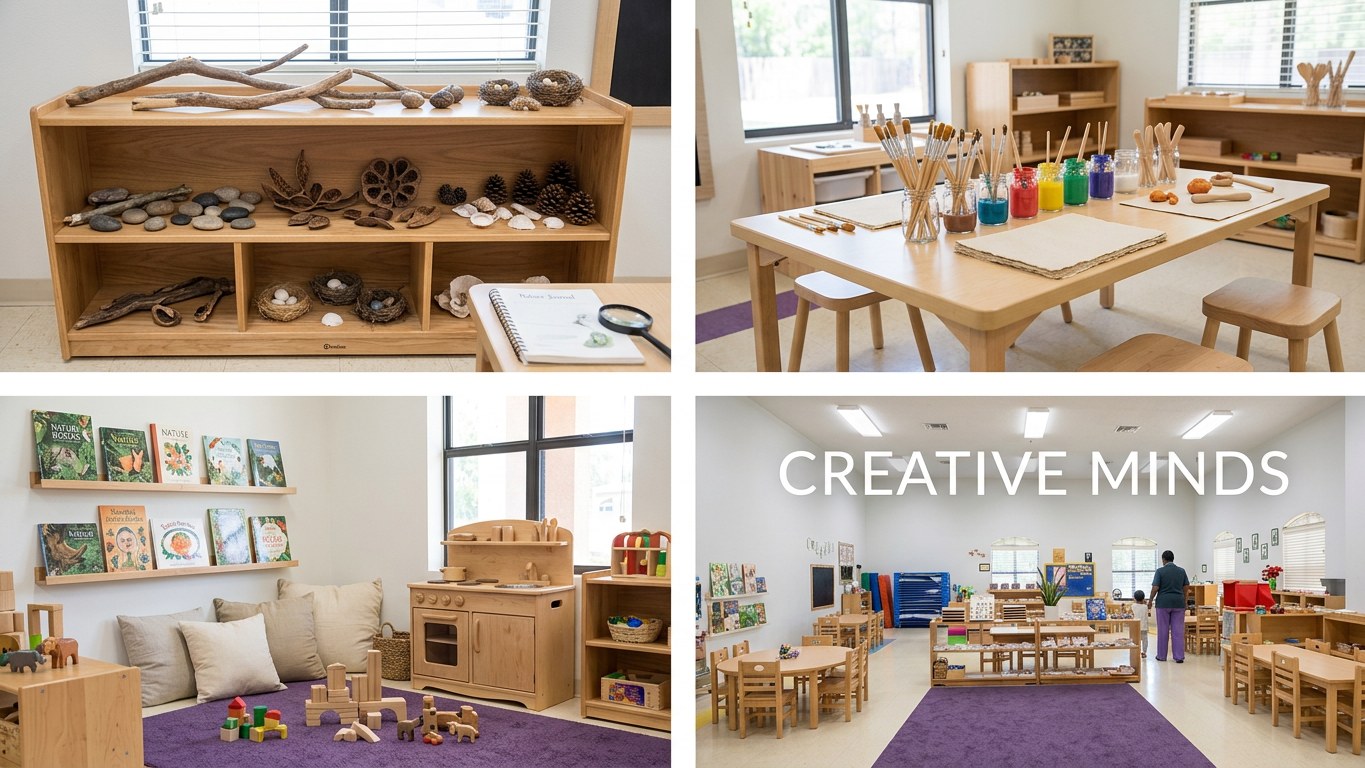
Creative Minds is the opposite shape: a single independent school in the Legacy and Warren corridor that serves children from six weeks through kindergarten entry and then hands them on to Frisco ISD or a private elementary. Everything about it is built around the Montessori method. Walk in mid-morning and the first thing you notice is the quiet hum of concentration: one child building the pink tower, another tracing sandpaper letters, a third carrying a tray of golden beads to a mat. The guide is not at the front of the room; she is kneeling next to one child, presenting one lesson, and the rest of the room is working on things they chose. Rooms are mixed-age on purpose, so a three-year-old watches a five-year-old read and a five-year-old learns patience by helping a three-year-old pour.
Layered over that structure is what the school calls the Waldorf touch: a weekly music class, process art with natural materials, rhythm and storytelling, and a deliberate reverence for beauty and nature in the rooms. Montessori builds the disciplined, capable mind; the artistic thread keeps the imagination glowing. Families who choose it tend to say this blend is why. Our Curriculum page lays out the five Montessori areas and what each looks like at each age.
The people are the second thing. Both infant teachers have been with the school since it opened its doors more than ten years ago, which in an industry where caregivers often change every few months means the same two warm faces greet families at drop-off year after year. Ratios meet or exceed Texas Health and Human Services licensing for every age, with the youngest rooms kept smallest, and because the school is small, the Director personally approves every move from one room to the next.
The third thing is a set of daily-life choices that are easy to verify. Food is treated as curriculum: organic milk and organic vegetables, no added raw sugar, minimal salt and fat, a vegetarian option every day, fresh fruit and milk with every lunch, and a nut-free building. Children under two have no screen time at all, and older children never more than one supplemental, education-aligned hour, never at meals or rest. Every classroom has a camera, and parents can log in and watch any time during the day. Our Our School page covers the rest.
Curriculum and daily life, compared
This is the heart of the decision, so it deserves a closer look than a table can give. The simplest way to say it: Primrose teaches children through a planned daily sequence delivered by the teacher, in a mix of whole-group, small-group and individual time; Creative Minds teaches children through a prepared environment they work in themselves, one lesson at a time. Both produce children who can read, count, and sit in a kindergarten circle. They get there by different roads, and the road is what you are choosing.
| Dimension | Primrose School of Lakehill | Creative Minds Montessori |
|---|---|---|
| Who directs the learning | Teacher-guided daily experiences from the Balanced Learning® sequence; whole-group, small-group and independent settings | Child-chosen work from a prepared environment; the guide presents individual lessons and observes |
| Named curricula | Balanced Learning®; strands called Thumbs Up!, Balanced Menus, Early Art Masters; Primrose enrichment units (zoology, chess, coding, drama, piano, cooking, magic, mindful movement) at participating schools | The Montessori materials (pink tower, sandpaper letters, movable alphabet, golden beads, number rods) plus a Waldorf-inspired arts and music thread |
| Age grouping | Single-age classrooms by stage, nine of them from Infant to Kindergarten; "Preschool Pathways" keeps a child with a consistent peer group between the twos and preschool | Mixed-age Montessori rooms (e.g., Casa 3–6); older children mentor younger |
| Technology | Not addressed on the Lakehill site; the system's coding unit is screen-free; parents get updates through the Procare app and a new Balanced Learning app | None under two; capped at one supplemental hour for older children |
| Languages and enrichment | Music ("Rhythm and Notes" is mentioned by the infant lead teacher), creative arts, and the enrichment units above; no language program is listed on the Lakehill site | Weekly music class, daily process art, physical-training time, enrichment across arts, music, language, and movement |
| Kindergarten readiness | Pre-K builds "emergent reading, writing, science, technology, engineering and math skills"; a private Kindergarten follows; the system cites a 96% ASQ problem-solving benchmark for Pre-K | Pre-K II / Transitional Kindergarten aligned with Frisco ISD; literacy, math, and writing through hands-on, project-based work and real classroom responsibilities |
| Assessment | Balanced Assessment: developmental screeners, nationally normed academic measures, observation; included in tuition | Observation records and parent-teacher conferences each November/December |
| Rest | Not detailed on the website; ask on your tour (one 2025–26 review, discussed below, says naps were dropped in the oldest room) | Supervised rest after lunch for children 12 months and up (about two hours); at least an hour of rest, sleep never required, quiet work for non-nappers |
| Potty training | Part of the Early Preschool program, taught in partnership with parents | Central focus of the Transition class from about 2½; no punishment tied to toileting, ever |
| Discipline | Character development and life skills are a curriculum strand; the owner's public reply to a review describes a parent-signed behavior policy under which a child may be sent home when behavior "cannot be safely de-escalated at school" | Positive guidance only; calm-down break capped at one minute per year of age; no punishment tied to food, naps, or toileting; no send-home policy for tantrums |
| Uniforms | Required from Pre-K through Kindergarten | Not required |
A few honest notes on this table. The Primrose program is genuinely broader in named activities, and some families love that: chess, coding, piano and drama units for preschoolers, a nutrition strand taught in the classroom, a kindergarten under the same roof so there is no school change at five, and an assessment system that produces numbers a parent can read. Montessori, by contrast, does not chase measurable acceleration; it is trying to build concentration, coordination, independence and order, and it trusts reading and math to follow. Our article on acceleration versus development is the long version of that argument, and it is fair to say we are not neutral on it.
Age grouping is the sharpest structural difference. Primrose moves a child through nine single-age rooms between infancy and kindergarten, each with its own teachers, which gives every year a fresh, age-matched program. Creative Minds keeps a child in one mixed-age Casa for three years with the same guide, which gives the child a long relationship and a room where they are the youngest, then the middle, then the leader. Both are defensible; they produce different kinds of confidence.

Food, hours, and the shape of a day
Hours. Primrose wins this one for commuting parents. Its website and Google listing say 6:30 AM to 6:00 PM, an hour more coverage per day than Creative Minds' 7:00 to 5:30. One wrinkle to ask about: the school's Texas HHS record lists permitted hours of 7:00 AM to 6:00 PM, a half hour later than the website's opening time. That is most likely a record that has not caught up with an earlier opening, but the state record is the legal document, so ask the front desk which is current. Creative Minds' full-day programs cap at ten hours of care, and the school asks for a 9:00 arrival so children get the uninterrupted work period that Montessori depends on.
Food. Both schools include meals, and both cook or cater rather than asking you to pack. The difference is who cooks and what goes in. Primrose has its own chef on staff and folds breakfast, lunch and snacks into tuition; the Balanced Menus strand teaches nutrition in the classroom, and the chef's profile says parents ask for his recipes. The Lakehill site does not publish sourcing details or an allergy policy, so ask to see next week's menu. Creative Minds has lunch catered by KidzCaters on a four-week rotation, with organic milk and organic vegetables, no added raw sugar, a vegetarian option every day, and a nut-free building; the menu is on our Nutrition page.
Flexibility. The Primrose state record lists part-time care, and the school bills weekly or monthly at the parent's choice; its after-school and summer programs mean a family with a first-grader and a toddler can use one campus. Creative Minds is a full-day school. It does offer ways to protect a spot during extended breaks (a one-time hold-spot fee of $250, or half a month's tuition for infants) and prorated tuition for absences of a week or more, but if you need two days a week, Primrose is the one to ask.
Safety, security, and seeing your child's day
Both schools describe security and health practices on their websites. The mechanisms differ enough to matter, and the biggest difference is how much of the day you can see.
| Primrose School of Lakehill | Creative Minds Montessori | |
|---|---|---|
| Getting in the door | Not detailed on the website; a "customized Safe School Plan" is posted in every classroom | Doors locked at all times; personal key fob per family; visitors ring the bell |
| Check-in / pick-up | Not detailed on the website | Fingerprint sign-in kiosk that records date, time, and a photo; photo ID for anyone unfamiliar; release only to authorized adults |
| Cameras in rooms | Not mentioned on the website | Video cameras in every classroom; secure family login throughout the day; grandparent logins available, $25 per child per month |
| Daily communication | Real-time updates and photos through the Procare app; a new Balanced Learning app | Daily email with meals, naps, activities, and photos; parent-teacher conferences each November/December |
| Staff training | Background checks for all staff; CPR and first-aid certification; training on signs of illness; continuous health and safety training | Certified Montessori guides; positive-guidance discipline policy; volunteers require an 8-hour pre-certification and criminal-history check |
| Illness | Children and staff with respiratory symptoms or fever stay home until fever-free for 24 hours; frequent disinfecting of high-touch toys; handwashing embedded in the curriculum | Fever 100.4°F+ stays home until fever-free 24 hours unmedicated; vomiting/diarrhea 24 symptom-free hours; group notified of communicable illness |
| Bedding | Crib sheets laundered daily; individual cots and blankets laundered weekly | Texas licensing, AAP and CPSC safe-sleep standards for infants: on the back, own CPSC-compliant crib, firm mattress, tight sheet |
| Visibility inside | Tour on request | Parents may visit in person any time during operating hours, no appointment |
The absence of a camera line on the Primrose site is not a verdict; many excellent schools choose not to stream classrooms, and the Procare photo feed is a real form of visibility. But if watching your child's actual room at 10:40 on a Tuesday is something you would use, it is a question to ask at Primrose and a feature you can test at Creative Minds on the tour.
What the state's five-year records show, side by side
The Texas Health and Human Services Commission publishes every licensed center's five-year compliance history in its public Child Care Search. We read both schools' pages on September 17, 2026 and put them in one table. Read ours as critically as theirs; the links go to the primary source.
| Five-year state record | Primrose School of Lakehill (state page) | Creative Minds Montessori (state page) |
|---|---|---|
| Permit | Full Permit issued July 18, 2019; no conditions; renewal due July 18, 2027 | Full Permit since April 21, 2016; no conditions; renewal due April 2028 |
| Serious injuries / injuries from standard violations | 1 / 1 (a July 2024 incident, self-reported by the school; see below) | 0 / 0 |
| Employees who left employment, by year | 2025: 11 · 2024: 13 · 2023: 16 · 2022: 18 · 2021: 22 · 2020: 19 | 2025: 5 · 2024: 7 · 2023: 15 · 2022: 18 · 2021: 14 · 2020: 22 |
| Activity, last 60 months | 11 inspections · 1 self-reported incident · 2 reports (complaint investigations, both found fully compliant) | 14 inspections · 3 self-reported incidents (filed by us; see below) · 4 reports (complaint investigations) |
| Deficiencies found / standards evaluated | 9 / 3,724 | 26 / 3,942 |
| Most recent full inspection | July 10, 2026: 646 of 647 standards compliant; 1 deficiency (medium-high: one caregiver's pediatric CPR certificate was not current), corrected July 24, 2026 | May 12, 2026: 657 of 660 compliant; 3 deficiencies. Latest visit July 21, 2026: 1 of 1, none |
| Administrative penalties | 0 | 0 |
| Corrective or adverse action | No / No | No / No |
| Texas Rising Star | Not shown on the state record (record shows "Accredited") | Entry Level |
| Licensed capacity | 176 | 226 |
What the nine Primrose deficiencies actually were, in full, so you are not left guessing. Five were paperwork or maintenance items corrected within days: two infant teachers' annual safe-sleep training was not on file and four infant feeding schedules were out of date (October 2021); playground loose-fill surfacing was low on two playgrounds (September 2022); no documentation of a July fire drill (August 2025); and one caregiver's CPR certificate was not current (July 2026). Three came from a single follow-up visit on November 4, 2021, and they are the ones to ask about: the inspector recorded that a caregiver in the 18-to-24-month room was found asleep while 13 children were in care (rated high risk), that three of ten open classrooms had teachers who did not know how many children they had (high), and that three children across two rooms had blankets over their heads at nap time (medium). The ninth is the injury on the record: on July 25, 2024 the school itself reported an incident in which, in the state's words, "a caregiver pulled a child arm in a manner that potentially caused an injury," cited as a prohibited punishment at the high risk level, with compliance verified on August 29, 2024. Nothing on the record since then has been above a medium-high paperwork item, and the two complaint investigations (August 2023 and October 2025) both found the standard evaluated compliant.
Two things about that record deserve credit. The 2024 incident is on the state's page because Primrose reported it, which is exactly what the rules ask of a school and what many centers quietly avoid; a self-reported incident is a sign of a school that tells the state the truth, and we would rather enroll at a school with one honest report than at one with a suspiciously blank page. And the deficiency count over five years, 9 across 3,724 standards, is cleaner than ours.
Our own record is the one we want you to read hardest. Twenty-six deficiencies across 3,942 standards is more than Primrose Lakehill's, and most of them are paperwork we should have had in order and many of which we reported ourselves. Each finding was verified corrected by the state. The three self-reported incidents on our record are incidents we reported to the state ourselves, because we would rather have a mark on the page than a secret in the building. Zero injuries in five years and 5 and 7 staff departures in the last two years are the numbers we are proudest of. The details are on our state page linked above, and we would rather you read them there than take our summary.
Cost and fees: what each school publishes
Here Primrose does something most Frisco schools, including us, do not: it prints its tuition. The Lakehill tuition page lists a weekly range for each classroom and says the rates include full-day care, the curriculum, meals and snacks, assessments and the daily app. It does not say what determines where in the range a family lands; the state record lists part-time care, so the low end may be a part-week schedule. Ask.
| Primrose Lakehill classroom | Published weekly tuition | Roughly per month (weekly × 52 ÷ 12) |
|---|---|---|
| Infant | $273 – $390 | $1,183 – $1,690 |
| Toddler | $262.50 – $375 | $1,138 – $1,625 |
| Early Preschool / Preschool Pathways | $252 – $360 | $1,092 – $1,560 |
| Preschool | $241.50 – $345 | $1,047 – $1,495 |
| Pre-Kindergarten | $234.50 – $335 | $1,016 – $1,452 |
| Kindergarten | $335 | $1,452 |
| After School (ages 5–12) | $112 – $150 | $485 – $650 |
| Summer Adventure Club | $310 per week | — |
Source: the school's tuition page on the Primrose website, read September 17, 2026. The page notes rates are subject to change and that additional fees or deposits may apply; the monthly column is our arithmetic, not the school's.
Primrose School of Lakehill bills weekly or monthly at the parent's choice, offers a limited number of hardship scholarships each year, and requires uniforms from Pre-K up (a cost the tuition page does not quantify). Enrichment units are included in tuition; vendor activities like soccer and dance are extra. Ask about the registration fee, any deposit, and what happens to your spot during a long absence.
Creative Minds Montessori bills monthly by age. Published fees: a $200 annual registration fee per child (at enrollment and each September 1), a $150 supply fee twice a year (March and September), and a $25-per-child monthly camera fee. Published credits: a sibling discount, $250 off tuition for you and each referred family once they complete their first full month, and a current new-family welcome of $100 off tuition for the first ten months. Meals, snacks, the music class and all materials are included. Monthly rates by age come from the Director, and we will give you a written all-in number on the tour. Details are on our Admissions page.
Two practical tips. First, ask both schools for a written, all-in annual number for your child's age, including every fee and the uniform, so a weekly range and a monthly rate can be compared like for like. Second, ask what happens to your spot and your money during a two-week vacation, a maternity leave, or a job change; the answers differ more between schools than the headline rate does. Our guide to what childcare really costs covers FSAs and the child-care tax credit, which apply at both schools.
What parents say
Primrose School of Lakehill
Start with the number: Primrose School of Lakehill holds a 4.8-star rating across 50 Google reviews, the higher of the two scores in this comparison, and it should frame everything below. The praise is specific and consistent. Parents name the infant teachers, one of whom has been there since 2002, and describe leaving a twelve-week-old with confidence. Several describe the school as an extension of their family. One 2025 reviewer explicitly credits "very low turnover" for the consistency their children got, which matches the trend on the state record. Families who stayed four years, or sent three children through from infancy to the private kindergarten, write the kind of farewell reviews a school earns only over time. The school's own testimonials page carries similar stories: a non-verbal two-year-old who started talking within weeks, a family relocating from Dallas who found the same standard they had left.
The critical reviews are few, and we will not brush them aside, because the one detailed account raises questions worth asking on a tour. Sorted by lowest rating, the two negative reviews we found were posted around the turn of 2026 by reviewers who share a surname and appear to describe the same family's departure after four years. The longer one, a mother's account, says the family withdrew a five-year-old after what she calls a pattern of unprofessional conduct: a teacher who gave her positive feedback while, she says, describing her son to other parents as a bad influence; repeated workday calls from the owner to pick the child up because of tantrums; naps removed entirely in the oldest room; her son placed with children seven and older during aftercare; a small bead he put in his ear that required a specialist visit; and a water bottle she sent that staff kept from him. She concludes the school "expects children to be submissive and compliant." The shorter review, from the other family member, says the owner's attitude made him feel unwelcome.
The owner replied publicly to both, and the reply is part of the record too. It says the school's parent-signed behavior policy requires the school to notify parents and request pick-up "when the behavior cannot be safely de-escalated at school," that the team implemented "multiple strategies" to help the child, and that the decisions were made "with the safety of all children in mind." We cannot verify either side, and one family's account is not a pattern. But it does tell you what the school's policy is, in the school's own words, and that is useful: Primrose Lakehill will send a child home for behavior it judges unsafe, and asks parents to sign that policy at enrollment. Some parents want exactly that firmness for the sake of the other 15 children in the room; others, especially parents of a spirited four-year-old, will want to read the policy carefully before signing.
What the state's data says about the pattern question: the record shows no complaint investigation that found a deficiency in five years, one self-reported incident of a caregiver pulling a child's arm in 2024, and a 2021 visit that found a sleeping caregiver, teachers who did not know their headcount, and children with blankets over their heads. Those are three separate moments across five years at a school licensed for 176 children, all corrected, none repeated on the record since 2024, and they sit alongside 11 routine inspections that found at most one deficiency each. Read together with 48 positive reviews out of 50, the fair summary is a well-regarded school with a firm behavior line, a past incident it handled the honest way, and staff turnover that has fallen every year since 2021.
Creative Minds Montessori
Creative Minds Montessori holds a 4.7-star rating across 44 Google reviews. It is a smaller school, so the count is smaller; the score is what we are proud of, and so is the state's record of 5 and 7 staff departures in the last two years, because the reviews are mostly about people who are still here. The Google reviews quoted on our Testimonials page cluster around a different set of themes than the Primrose ones: the infant teachers who have been here since the school opened, the calm of the classrooms, the food, the cameras, and children who come home and set the table without being asked. We are not going to pretend we have no critical reviews; read all 44 on Google and ask us about any of them on the tour. We would rather answer than spin.
A Frisco mother who toured both kinds of school told us the same thing we hear often: the tours were not really about the same question. At the larger campus, she found herself asking how the day was organized. In our Casa room, she found herself watching one child work for twenty minutes without looking up. Both were good signs. They were just signs of different things.
Which school fits which family
Primrose School of Lakehill is probably the better fit if…
- You need care before 7:00 AM or after 5:30 PM. That extra hour is decisive for many two-commute households.
- You want one campus from infancy through a private kindergarten, with after-school care and a summer club for older siblings up to twelve.
- You want to see the price before you tour. Primrose posts weekly tuition by classroom; we do not.
- You prefer a structured, teacher-guided, single-age classroom with a national curriculum, formal assessments, and named enrichment units like chess, coding and piano.
- An on-site chef cooking breakfast, lunch and snacks matters more to you than organic sourcing.
- You value a national system's standardization plus owners who have run this exact campus since 2013, and the cleaner five-year deficiency count (9 to our 26).
- You want a school with a firm, written behavior policy and are comfortable signing it.
Creative Minds Montessori is probably the better fit if…
- You want an authentic Montessori education: mixed-age rooms, self-chosen work, the classic materials, long uninterrupted work periods, and certified guides.
- You want no screens for your baby or toddler and very little after that, as policy rather than as a favor.
- Organic milk and vegetables and no added sugar matter to you enough to see them on the menu.
- You want your infant with the same two caregivers year after year, and small rooms where the Director personally approves each move up. Staff stability is our strongest number on the state record: 5 departures in 2025, 7 in 2024, and zero injuries in five years.
- You would use all-day camera access and a daily photo email, and you want to be able to walk in unannounced.
- You want a positive-guidance discipline policy with no send-home rule for tantrums, and a child who "can't do it" met with a lesson rather than a label.
- You are fine with a 7:00–5:30 day and with changing schools at kindergarten.
And a third possibility that is more common than either school likes to admit: some children are simply happier in one kind of room than the other, and you will know within ten minutes of watching them in it. Bring your child to both tours if you possibly can. Creative Minds offers a Discovery Day before enrollment for exactly this reason; ask Primrose whether your child can spend part of a morning in the room they would join.
Ten questions to ask on both tours
These are the questions that separate a good tour from a brochure read aloud. Ask every one of them at both schools, in the same words, and compare the answers side by side.
- "What is the exact ratio and group size in the room my child would start in, today?" Not the licensing maximum, the actual number this month.
- "How long have the teachers in that room been here?" Tenure is the single best predictor of how your child's day will feel. Primrose's staff page gives you a head start; check it against the room.
- "What happens when a child says, 'I can't do it'?" The answer reveals the whole philosophy. We explain why in our guide to choosing a whole-child program.
- "What is your written behavior policy, and when do you call a parent to pick up?" Ask to read it before you sign it, at both schools.
- "Can I see my child's room during the day, and how?" Cameras, an app, a window, or an open door. Get the specifics and the cost.
- "What did the children eat yesterday, and where was it cooked?" Then ask to see the menu for next week and the allergy policy.
- "How much screen time will my child have, and what is it for?" Get a number, not an adjective.
- "How do naps work in the oldest room, and when do they stop?" Age, readiness, or a room-wide rule, and who decides.
- "What is my all-in annual cost for this age, including every fee and the uniform, and what happens to my spot if we take three weeks off?"
- "When a parent raises a concern about a teacher, what happens in the next 48 hours, and what did you report to the state last year?" Ask for a real example. Compare the answer with the self-reported-incident count on the school's state page.
For the longer version of this checklist, including the unannounced-visit test and the difference between settling-in tears and real red flags, see How to Choose a Daycare You Actually Trust.

The bottom line
Primrose School of Lakehill is a well-run, well-regarded campus with a national curriculum behind it and owners in the building every day: long hours, a chef, a private kindergarten and programs to age twelve, printed tuition, a 4.8-star Google rating, the cleaner five-year deficiency count in this comparison, and a staff page that shows a core of people who have been there a decade or more. Its state record carries one serious injury from 2024 that the school reported itself, a 2021 visit it will not enjoy being reminded of, and a firm behavior policy that one family found too firm. Those are all things to ask about, not reasons to skip the tour.
Creative Minds Montessori is a smaller, narrower, deeper offer: one philosophy carried out faithfully from infancy to kindergarten, with a food and screen policy you can see on the plate, infant teachers who have been there since day one, positive guidance with no send-home rule, and cameras you can watch all day. Its state record carries more paperwork deficiencies over five years than its neighbor's, which we own, and zero injuries and the lower staff turnover, which we are proud of.
Those are different products, and a family can be right to choose either. The wrong choice is the one made from a website, including this one. Tour both. Bring the questions above. Watch the children more than the adults. And if you would like to start with us, book a 40-minute weekday tour at Creative Minds, call (972) 338-4304, or email director@creativemindsfrisco.com. Primrose School of Lakehill schedules tours through its website or at (972) 210-0790.
Quick answers
How far apart are the two schools?
Both are on Warren Parkway in West Frisco, ZIP 75034: Primrose at 5349 Lakehill Blvd near The Star, Creative Minds at 5115 Warren Parkway behind Dua Trattoria at Legacy and Warren. They are minutes apart, so touring both in one morning is realistic.
Which has longer hours?
Primrose: 6:30 AM to 6:00 PM per its website (the state record lists 7:00 AM to 6:00 PM; ask which is current). Creative Minds: 7:00 AM to 5:30 PM, up to ten hours of care per day. Both are Monday through Friday.
Which serves older children?
Primrose serves infants through a private kindergarten, plus an after-school program and a summer club for ages 5 to 12. Creative Minds serves 6 weeks through kindergarten entry.
Does either publish tuition?
Primrose does: weekly ranges by classroom, from $234.50–$335 for Pre-K to $273–$390 for infants, with kindergarten at $335 a week, as of September 2026. Creative Minds publishes its fees ($200 annual registration, $150 supply fee twice a year, $25 monthly camera fee) and credits (sibling discount, $250 referral, $100-a-month welcome credit for ten months); monthly rates come from the Director.
Do both have parent cameras?
Creative Minds offers all-day secure classroom viewing for $25 per child per month, with grandparent logins available. Primrose's website does not mention classroom cameras; it shares daily updates and photos through the Procare app. Ask on the tour.
Is Primrose School of Lakehill a licensed center?
Yes. Texas HHS lists it as a Licensed Center – Child Care Program with a Full Permit issued July 18, 2019, Operation No. 1692989, Denton County, licensed capacity 176, marked Accredited, with part-time and after-school care and field trips. Both schools' inspection histories are public in the Texas Child Care Search.
What do the Texas licensing records show for each school?
Over five years, both have zero penalties and no corrective or adverse action. Primrose Lakehill shows 9 deficiencies across 3,724 standards evaluated, one serious injury (a self-reported July 2024 incident in which a caregiver pulled a child's arm), 11 and 13 staff departures in 2025 and 2024, and two complaint investigations that found no deficiency. Creative Minds shows 26 deficiencies across 3,942 standards, including three supervision findings (2022, 2023 and a self-reported one in June 2026), all verified corrected, plus 3 self-reported incidents, zero injuries in the same years.
Keep reading
- How to Choose a Daycare You Actually Trust — the full checklist, the unannounced-visit test, and real red flags.
- Kids 'R' Kids Legacy West vs. Creative Minds Montessori — our other West Frisco comparison, same method.
- What Should Parents Look For? Choosing a Whole-Child Program — eight questions that reveal a program's beliefs.
- Acceleration vs. Development — the honest trade-off behind kindergarten-readiness numbers.
- Early Childhood Education Methodologies — Montessori, Reggio, Waldorf, and seventeen other approaches compared.
- How Much Does Childcare Cost — FSAs, tax credits, and why continuity beats the cheapest slot.
- Our Curriculum and Our Nutrition Program — see the claims in this article for yourself.
About this comparison: written by the teachers of Creative Minds Montessori, Frisco, TX, in September 2026. Facts about Primrose School of Lakehill come from its public website (home, classrooms, tuition, staff and FAQ pages, read September 17, 2026), from the Primrose Schools corporate site (about and enrichment pages), from its Texas HHS Child Care Search record (permit, capacity, programs, hours, administrator, and the full five-year inspection and compliance history, read the same day), and from public Google reviews and the owner's public replies as of the same date; review counts, ratings and rates change. Facts about Creative Minds come from our own website and our Texas HHS record. Quotations from reviews and from the state record are reproduced as posted; individual reviews are the opinions of their authors and are unverified. Primrose Schools, Balanced Learning, Active Minds Healthy Bodies Happy Hearts, and the enrichment program names are trademarks of their owner; we use them only to identify the programs. If you are the owner or director of Primrose School of Lakehill and find an error, or want to add context to anything here, email director@creativemindsfrisco.com and we will correct or add it promptly and note the change. Nothing here is a substitute for your own tour of both schools. Our legal disclaimer applies.
← Back to Parent Resources