


Two schools that both use the word Montessori, about twenty minutes apart, with very different shapes. GenStar Montessori Academy in north Plano is the bigger, longer-reaching one: licensed for 267 children from six weeks to twelve years, open 6:30 AM to 6:30 PM, NAEYC-accredited with a 4-star Texas Rising Star rating on its website, before- and after-school care with school transportation on its state record, a private kindergarten with weekly Spanish, and the lowest staff-departure numbers of any school we have compared (four in 2025, five in 2024). Its infant and toddler rooms run on the Frog Street curriculum, with Montessori introduced from the two-year-old room up. Creative Minds Montessori is the smaller, narrower one: six weeks through kindergarten entry, certified Montessori guides from the infant room up, mixed-age classrooms with a Waldorf-inspired arts thread, organic milk and vegetables with no added sugar, no screens under two, and all-day parent cameras. Both hold Full Permits with no penalties and no enforcement actions, and both carry 26 deficiencies on their five-year Texas records (GenStar's across 4,083 standards evaluated, ours across 3,942). Nine of GenStar's are rated high, including supervision, safe-sleep, ratio and reporting findings between 2021 and 2026; seven of ours are rated high, and we own them below. Google rates GenStar 4.9 stars across 120 reviews and Creative Minds 4.7 across 44. If you need one campus from infancy through after-school pick-up at twelve, with a bus and long hours, GenStar offers that and we do not. If you want a small school where the Montessori method starts in the infant room and you can watch it from your phone, that is what we are.
Two Montessori schools, two cities
GenStar Montessori Academy sits at 10205 Custer Road, Plano, TX 75025, on the northern edge of Plano near the Custer Road and Hedgcoxe Road corridor, a few minutes south of the Frisco and McKinney lines. Creative Minds Montessori is at 5115 Warren Parkway, behind Dua Trattoria at Legacy Drive and Warren Parkway, in West Frisco 75034. Depending on traffic they are about twenty minutes apart, more at rush hour, which for many families is the first fact that matters: one of these schools is probably on your commute and the other probably is not.
Both schools describe Montessori classrooms, and for the three-to-six-year-olds both mean it in the classic way: mixed ages, shelves of materials, self-chosen work, a guide who observes and presents. Below that age the two schools diverge more than their names suggest. GenStar's website says its infant and toddler programs use the Frog Street curriculum, a published early-childhood curriculum built on brain-development research, and that its two-year-old room uses Frog Street "as a guideline" while introducing Montessori. Creative Minds runs the Montessori method, with certified guides, from the infant room up. Neither is wrong; they are different bets about the first three years, and this guide tries to make that difference concrete enough to choose on.
At a glance
| GenStar Montessori Academy | Creative Minds Montessori | |
|---|---|---|
| Address | 10205 Custer Rd, Plano, TX 75025-5138 (north Plano, near Custer Rd & Hedgcoxe Rd) | 5115 Warren Parkway, Frisco, TX 75034-6289 (behind Dua Trattoria, Legacy Dr & Warren Pkwy) |
| Phone | (972) 544-6652 | (972) 338-4304 |
| Ownership and age | Single-campus school; a parent testimonial on the school's site says it opened in 2019; Full Permit since October 9, 2019 (state record) | Single independent school, open more than ten years at this location; Full Permit since April 21, 2016 |
| Leadership | Nada Guirguis, Administrator/Director on the Texas HHS record; the school's website names "Ms. Jacquie" as Director and "Ms. Nada" as Co-Director; nine staff pictured on the staff page, without credentials listed | Dinna Bacordo, Director; meet the team on our Our Team page |
| Hours | 6:30 AM – 6:30 PM, Mon–Fri (website and state record agree) | 7:00 AM – 5:30 PM, Mon–Fri (up to 10 hours of care; arrive by 9:00 AM) |
| Ages served | 6 weeks through 12 years: Infants, Toddlers, Pre-Primary (two-year-olds), Primary (3–6), Kindergarten (5+), After School and Summer Camp (6–12) | 6 weeks through kindergarten entry (Pre-K II / Transitional Kindergarten) |
| Texas state license | Licensed Center – Child Care Program, Full Permit, no conditions; Texas HHS Operation No. 1688813, Collin County; accepts child care subsidies (state record) | Licensed Center – Child Care Program, Full Permit, no conditions; Texas HHS Operation No. 1597616 (listed as "Creative Minds"), Denton County |
| Accreditation / quality rating | NAEYC accreditation and a 4-out-of-4-star Texas Rising Star certification (school's website); American Montessori Society and Texas Licensed Child Care Association listed as memberships | Texas Rising Star Entry Level (the base certification tier) |
| Licensed capacity | 267 children (state record) | 226 children (state record); classrooms kept small by design |
| Services on the state record | Before-school and after-school care; school-age care; transportation to and from school; meals and snacks provided; part-time care; field trips | Full-day programs; field trips with parent volunteers; meals and snacks provided; no transportation |
| Educational approach | Frog Street curriculum in Infants and Toddlers; Frog Street "as a guideline" plus Montessori in Pre-Primary; Montessori in Primary (mixed-age 3–6; Practical Life, Sensorial, Language, Mathematics, Cultural, Art, Music and Movement) and Kindergarten; "uninterrupted blocks of work time" and "multi age groupings" described on the About Montessori page | Montessori from six weeks: prepared environment, self-chosen work, mixed-age rooms, five areas (practical life, sensorial, language, math, cultural) with a Waldorf-inspired arts, music, and nature thread |
| Teacher credentials | "Degreed and American Montessori Society (AMS) certified teachers" (Why Choose GenStar page); the staff page lists no individual credentials | Certified Montessori guides; the infant leads have been here since the school opened |
| Enrichment | Music and Movement and Art as Primary curriculum areas; weekly Spanish, cooking, stitching and etiquette in Kindergarten; a gymnasium and computer lab for after-school | Weekly music class, daily process art, physical-training time, enrichment across arts, music, language, and movement |
| Meals | Meals and snacks provided (state record); the website does not describe the menu, kitchen or sourcing | Breakfast, lunch, and two snacks; lunch catered by KidzCaters on a four-week rotation; organic milk and organic vegetables, no added raw sugar, vegetarian option daily; nut-free |
| Classroom cameras | Not mentioned on the school's website; daily updates come through the Brightwheel app | Secure login to your child's room throughout the day; grandparents can get their own login; $25 per child per month |
| Screens | Not addressed for preschool; a computer lab is listed for the after-school program | No screen time under age two; at most one supplemental, education-aligned hour for older children, never at meals or rest |
| Beyond preschool | Private Kindergarten; before- and after-school program with homework help, gymnasium and play structure; summer camp to age 12 | Not offered; the program ends at kindergarten entry |
| Communication | Daily communication via the Brightwheel app; parent-teacher conferences twice a year with a developmental assessment | Daily email with meals, naps, activities, and photos; parent-teacher conferences each November/December |
| Tuition transparency | No rates or fees on the website; enrollment is completed through a Brightwheel invitation after a decision to join | Rates from the Director; $200 annual registration, $150 supply fee twice a year, sibling discount, $250 referral credit, $100/month welcome credit for 10 months |
| Google rating | 4.9 stars (120 reviews); the school's own testimonials page separately shows 64 five-star testimonials dated 2023–2026 | 4.7 stars (44 reviews) — see our Testimonials page |
Sources: each school's website and Texas HHS record, September 22, 2026; Google ratings and review counts as of the same date. Details change — confirm on your tour.
What kind of school each one is
GenStar Montessori Academy: an accredited, all-ages campus that blends two curricula
GenStar's website is short on history, so here is what it does say. The school is at 10205 Custer Road in north Plano, takes children "from 6 weeks to 12 years of age," and runs Monday to Friday from 6:30 in the morning to 6:30 at night. Its state record shows a Full Permit issued on October 9, 2019, and a parent on the school's testimonials page mentions that it opened in 2019, which fits. The home page and the accreditation page lead with two credentials that are genuinely uncommon for a preschool in this area: accreditation by the National Association for the Education of Young Children, and "4 out of 4 Star Certification" from Texas Rising Star, the state's quality-rating system, which the school says covers director and staff qualifications, ratios, curriculum, nutrition and activities, and parent involvement. The same page lists the American Montessori Society and the Texas Licensed Child Care Association as memberships. The mission page describes "love and respect for children integrated with a research-based curriculum," aimed at milestones in language, literacy, social and emotional development, physical development, creative expression, cognition and executive function, and lists integrity, compassion, accountability, respect and empathy as core values.
The program pages are where the school's real shape shows. The Infants page says plainly, "We use the Frog Street curriculum in our Infant Program," with individualized lesson plans based on each child's stage and an emphasis on teacher-child interaction for oral language and emotional connection. The Toddlers page says the same: Frog Street, "brain development research as the framework for instruction," strong daily routines, and "a balance of intentional instruction with child directed play." The Pre-Primary page, for two-year-olds, is the hinge: "We use the Frog Street curriculum as a guideline in this program and introduce Montessori as well," with potty training described as "a fundamental point in this classroom." Only at Primary, for three-to-six-year-olds, does the page read as a Montessori classroom in the classic sense: children "work together and enjoy mentoring one another" across the age span, in a room with distinct areas for Practical Life, Sensorial, Language, Mathematics, Cultural Subjects, Art, and Music and Movement, each with "shelves with a variation of engaging Montessori materials." The About Montessori page adds "uninterrupted blocks of work time, and guided choice of work activity" and says "each of our classrooms have multi age groupings that foster peer learning."
Then comes what we do not offer. GenStar's Kindergarten page describes a private kindergarten for five-year-olds with a "low teacher-to-child ratio," language arts through reading, writing, spelling and grammar with "weekly Spanish lessons," mathematics through addition, subtraction, multiplication and division using the geometry cabinet and constructive triangles, geography, botany and zoology, and practical life that includes food preparation, cooking, stitching and etiquette, all aimed at a child "prepared for first grade and beyond." The After School page lists homework help, indoor and outdoor activities, a "state-of-the-art gymnasium," an age-appropriate play structure and a computer lab, and the state record confirms before-school care, after-school care, school-age care and transportation to and from school. Summer camp runs to age twelve. The Why Choose GenStar page promises "degreed and American Montessori Society (AMS) certified teachers," daily communication through the Brightwheel app, and two parent-teacher conferences a year with a developmental assessment. The staff page shows nine team members by first name and photo, without credentials, and invites parents to ask.
Two more things worth knowing before the tour. The state's count of employees who left is the lowest of any school we have compared: three in 2021, five in 2022, eight in 2023, five in 2024 and four in 2025, at a school licensed for 267 children. That is a remarkable number and it deserves to be said first. The second is that the same state record carries 26 deficiencies over five years, nine of them rated high, concentrated in 2022 and late 2023, and we lay every one of them out below so you can weigh the two facts together.

Creative Minds Montessori: one school, one philosophy, ten-plus years of the same faces
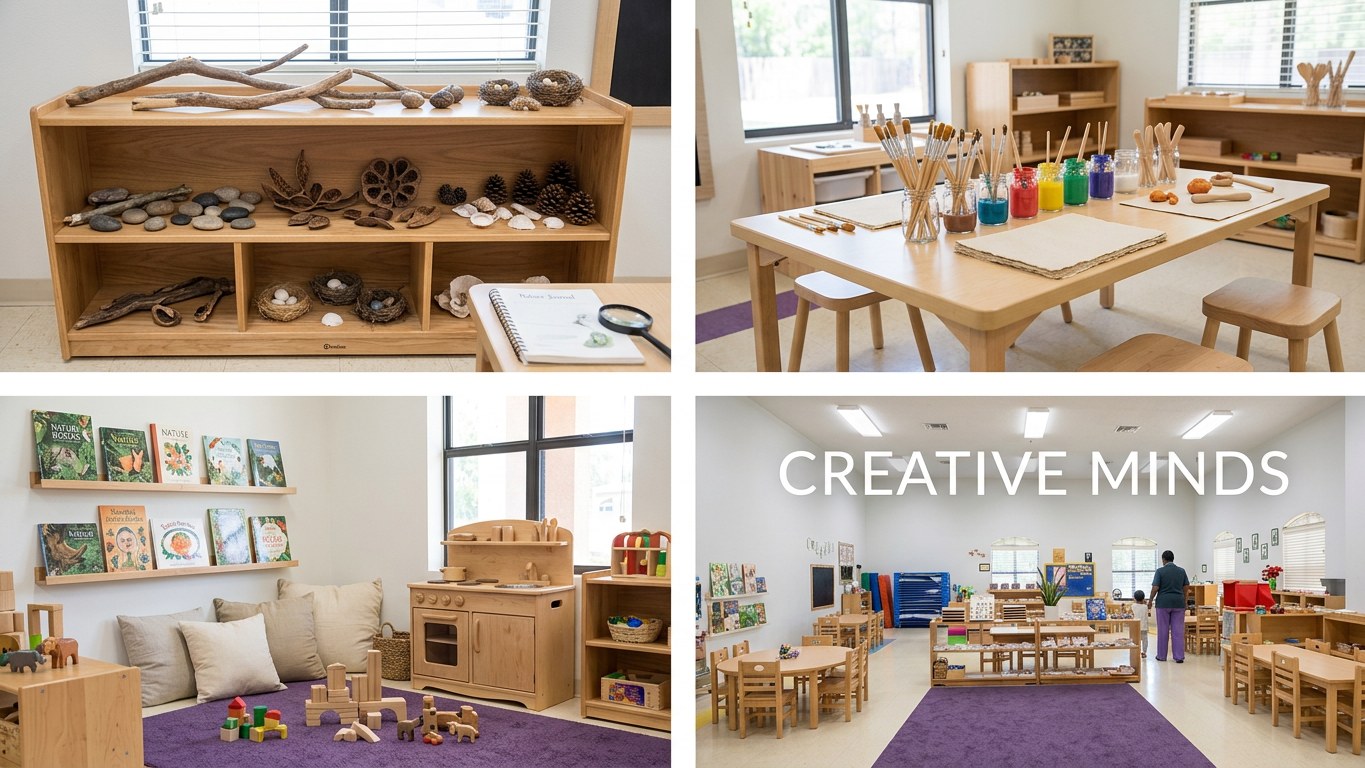
Creative Minds is a single independent school in the Legacy and Warren corridor that serves children from six weeks through kindergarten entry and then hands them on to Frisco ISD or a private elementary. Everything about it is built around the Montessori method, from the infant room up. Walk in mid-morning and the first thing you notice is the quiet hum of concentration: one child building the pink tower, another tracing sandpaper letters, a third carrying a tray of golden beads to a mat. The guide is not at the front of the room; she is kneeling next to one child, presenting one lesson, and the rest of the room is working on things they chose. Rooms are mixed-age on purpose, so a three-year-old watches a five-year-old read and a five-year-old learns patience by helping a three-year-old pour.
Layered over that structure is what the school calls the Waldorf touch: a weekly music class, process art with natural materials, rhythm and storytelling, and a deliberate reverence for beauty and nature in the rooms. Montessori builds the disciplined, capable mind; the artistic thread keeps the imagination glowing. Our Curriculum page lays out the five Montessori areas and what each looks like at each age.
The people are the second thing. Both infant teachers have been with the school since it opened its doors more than ten years ago, which in an industry where caregivers often change every few months means the same two warm faces greet families at drop-off year after year. Ratios meet or exceed Texas Health and Human Services licensing for every age, with the youngest rooms kept smallest, and because the school is small, the Director personally approves every move from one room to the next.
The third thing is a set of daily-life choices that are easy to verify. Food is treated as curriculum: organic milk and organic vegetables, no added raw sugar, minimal salt and fat, a vegetarian option every day, fresh fruit and milk with every lunch, and a nut-free building. Children under two have no screen time at all, and older children never more than one supplemental, education-aligned hour, never at meals or rest. Every classroom has a camera, and parents can log in and watch any time during the day. Our Our School page covers the rest.
Curriculum and daily life, compared
For a three-year-old, this is a Montessori-versus-Montessori comparison and the table below has few sharp contrasts. For a baby or a toddler it is a Montessori-versus-Frog-Street comparison, and that is the difference to understand before you tour either school. Frog Street is a widely used, research-based early-childhood curriculum built around themed units, teacher-planned activities and developmental domains; Montessori infant and toddler rooms are built around a prepared environment, freedom of movement, real objects and self-care, with the adult observing more than instructing. Both can produce a happy, talkative two-year-old. They feel different in the room.
| Dimension | GenStar Montessori Academy | Creative Minds Montessori |
|---|---|---|
| Who directs the learning | Infants and Toddlers: Frog Street, "intentional instruction with child directed play," teacher "coaching and interacting with purpose"; Primary: child-chosen work from Montessori shelves with "uninterrupted blocks of work time" | Montessori at every age: child-chosen work from a prepared environment; the guide presents individual lessons and observes |
| Materials and areas | Primary: Practical Life, Sensorial, Language, Mathematics, Cultural Subjects, Art, Music and Movement; Kindergarten adds the geometry cabinet, constructive triangles, geography, botany and zoology | The Montessori materials (pink tower, sandpaper letters, movable alphabet, golden beads, number rods) across the same five areas, plus a Waldorf-inspired arts and music thread |
| Age grouping | Infants, Toddlers, Pre-Primary (twos) and Kindergarten by stage; Primary is mixed-age 3–6; the About Montessori page says all classrooms have "multi age groupings" | Mixed-age Montessori rooms (e.g., Casa 3–6); older children mentor younger |
| Teacher credentials | "Degreed and AMS certified teachers" (website); no individual credentials on the staff page; NAEYC accreditation and 4-star Texas Rising Star cover staff qualifications | Certified Montessori guides; the infant leads have been here since opening |
| Starting age | 6 weeks | 6 weeks |
| Infants | Frog Street: individualized lesson plans by developmental stage; five domains; teacher-child interaction for language; daily Brightwheel updates | Nido: individual schedules, safe-sleep standards, daily email with meals, naps, activities and photos |
| Languages and enrichment | Weekly Spanish in Kindergarten; Music and Movement and Art in Primary; cooking, stitching and etiquette in Kindergarten; gymnasium and computer lab for after-school; cultural celebrations praised in testimonials | Weekly music class, daily process art, physical-training time, arts, music, language, and movement |
| Technology | Not addressed for preschool; computer lab in after-school | None under two; capped at one supplemental hour for older children |
| Kindergarten and beyond | Private Kindergarten on campus; after-school care with homework help to age 12; summer camp | Pre-K II / Transitional Kindergarten aligned with Frisco ISD; the program ends at kindergarten entry |
| Rest | Not described on the website | Supervised rest after lunch for children 12 months and up (about two hours); at least an hour of rest, sleep never required, quiet work for non-nappers |
| Potty training | "A fundamental point" of the Pre-Primary (two-year-old) room | Central focus of the Transition class from about 2½; no punishment tied to toileting, ever |
| Discipline | Not described on the website; "self-regulation skills" and "grace" are curriculum goals | Positive guidance only; calm-down break capped at one minute per year of age; no punishment tied to food, naps, or toileting; no send-home policy for tantrums |
| Assessment and communication | Developmental assessment at two conferences a year; daily Brightwheel communication; Brightwheel also handles enrollment | Observation records; daily email; conferences each November/December; all-day cameras |
A few honest notes. GenStar's range is genuinely larger than ours: a private kindergarten with Spanish and real cooking, a gymnasium, a computer lab, homework help, a bus to and from local schools, and a summer camp, so a family with a first-grader and a baby can use one building for years. NAEYC accreditation is a serious, externally reviewed credential that we do not hold, and a 4-star Texas Rising Star rating sits three tiers above our Entry Level. On our side the differences are specific: we run Montessori, with certified guides, from the infant room rather than from the two-year-old room; we put organic sourcing and a no-added-sugar rule on the menu; we keep screens out of the early years by policy; and we let you watch the room from anywhere. If the Montessori method in the first two years matters to you, ask GenStar to show you the infant and toddler rooms and explain exactly how Frog Street and Montessori divide the day. If accreditation and a rated quality system matter more, GenStar has the paper and we do not.

Food, hours, and the shape of a day
Hours. GenStar wins this one comfortably: 6:30 AM to 6:30 PM, on the website and the state record alike, is a full hour and a half more coverage per day than Creative Minds' 7:00 to 5:30. For a household with two commutes into Dallas that is often decisive. Creative Minds' full-day programs cap at ten hours of care, and the school asks for a 9:00 arrival so children get the uninterrupted work period that Montessori depends on. One review of GenStar, discussed below, says the school asked for pick-up by 6:00 even though it closes at 6:30; ask what the practical last pick-up time is.
Food. GenStar's state record lists meals and snacks as provided, and its Texas Rising Star rating includes a nutrition category, but the website does not describe the kitchen, the menu, allergy handling or sourcing, so ask to see next week's menu and where it is cooked. Creative Minds does not cook on site; lunch is catered by KidzCaters on a four-week rotation, and the choices are in the sourcing: organic milk and organic vegetables, no added raw sugar, minimal salt and fat, a vegetarian option every day, fresh fruit and milk with every lunch, and a nut-free building. Our menu is on our Nutrition page.
Flexibility and transportation. GenStar's state record lists part-time care, before- and after-school care, school-age care and transportation to and from school, and its after-school page describes homework help and a gym. Creative Minds is a full-day preschool with no transportation. We do offer ways to protect a spot during extended breaks (a one-time hold-spot fee of $250, or half a month's tuition for infants) and prorated tuition for absences of a week or more, but if you need a bus from a Plano ISD elementary or a part-week schedule, GenStar is the one to ask. GenStar's state record also shows it accepts child care subsidies; ours does not.
Safety, security, and seeing your child's day
GenStar's website says little about security, cameras or illness, and we do not hold that against it; many good schools keep those details for the tour and the parent handbook, which GenStar links from its parent-resources page. What follows is what each site publishes, and where it is silent we say so.
| GenStar Montessori Academy | Creative Minds Montessori | |
|---|---|---|
| Getting in the door | Not described on the website; a 360° virtual tour of the building is offered online | Doors locked at all times; personal key fob per family; visitors ring the bell |
| Check-in / pick-up | Brightwheel app for enrollment and daily communication; pick-up procedure not described | Fingerprint sign-in kiosk that records date, time, and a photo; photo ID for anyone unfamiliar; release only to authorized adults |
| Cameras in rooms | Not mentioned on the website | Video cameras in every classroom; secure family login throughout the day; grandparent logins available, $25 per child per month |
| Daily communication | Daily updates through Brightwheel; two conferences a year with a developmental assessment | Daily email with meals, naps, activities, and photos; parent-teacher conferences each November/December |
| Staff | "Degreed and AMS certified teachers"; "carefully vetted" team (website); NAEYC and 4-star Texas Rising Star; the state's May 2025 inspection found all ten staff files reviewed had online-only CPR training, corrected within a month (see below) | Certified Montessori guides; positive-guidance discipline policy; volunteers require an 8-hour pre-certification and criminal-history check |
| Outdoor and indoor play | Gymnasium and age-appropriate play structure (after-school page); playground surfacing was cited in June 2023 and corrected | Fenced playground; physical-training time; nature and gardening as part of the day |
| Illness | Not described on the website | Fever 100.4°F+ stays home until fever-free 24 hours unmedicated; vomiting/diarrhea 24 symptom-free hours; group notified of communicable illness |
| Infant safe sleep | Not described on the website; the state cited crib and sleep-device items in 2022, 2023 and 2026 (see below) | Texas licensing, AAP and CPSC standards: on the back, own CPSC-compliant crib, firm mattress, tight sheet; the state cited us on two safe-sleep items in June 2023 (see below) |
| Transportation | Transportation to and from school on the state record; one 2022 review describes a missed school pick-up (below) | None |
| Visibility inside | 360° virtual tour online; in-person tours by contacting the school | Parents may visit in person any time during operating hours, no appointment |
What the state's five-year records show, side by side
The Texas Health and Human Services Commission publishes every licensed center's five-year compliance history in its public Child Care Search. We read both schools' pages on September 22, 2026 and put them in one table. Read ours as critically as theirs; the links go to the primary source.
| Five-year state record | GenStar Montessori Academy (state page) | Creative Minds Montessori (state page) |
|---|---|---|
| Permit | Full Permit since October 9, 2019; no conditions | Full Permit since April 21, 2016; no conditions |
| Serious injuries / injuries from standard violations | 0 / 0 on the state's injury counters (one December 2022 supervision finding says a child "was not attended immediately" and that this "resulted in injuries to child"; see below) | 0 / 0 |
| Employees who left employment, by year | 2025: 4 · 2024: 5 · 2023: 8 · 2022: 5 · 2021: 3 · 2020: 14 | 2025: 5 · 2024: 7 · 2023: 15 · 2022: 18 · 2021: 14 · 2020: 22 |
| Activity, last 60 months | 23 inspections · 1 self-reported incident · 5 reports (complaint investigations) | 14 inspections · 3 self-reported incidents (filed by us) · 4 reports (complaint investigations) |
| Deficiencies found / standards evaluated | 26 / 4,083 (9 high, 9 medium-high, 8 medium) | 26 / 3,942 (7 high, 12 medium-high, 6 medium, 1 medium-low) |
| Most recent full inspection | April 15, 2026: 691 of 692 standards compliant; 1 deficiency (high: a four-month-old asleep on their back in a sleep sack the inspector cited under the crib-bedding rule). Follow-up April 24, 2026: 1 of 1 compliant | May 12, 2026: 657 of 660 compliant; 3 deficiencies (record-keeping and orientation training, all corrected by May 28). June 17, 2026: a self-reported incident, 1 deficiency (below). July 21, 2026: 1 of 1 compliant |
| Administrative penalties | 0 | 0 |
| Corrective or adverse action | No / No | No / No |
| Texas Rising Star | 4 of 4 stars (school's website) | Entry Level |
| Licensed capacity | 267 | 226 |
What GenStar's 26 deficiencies were, in full, because a count without the narratives tells you nothing. They cluster into three periods.
2021, the first full year on the record. The September 23, 2021 inspection (667 standards) found five items: no annual fire-marshal inspection for the year, fire-drill documentation not recorded since February, two of ten children's records missing a health-care provider statement, two records missing immunizations, and training records unavailable for nine of ten personnel files. All five were corrected within days and verified by October 5. Then on November 4, 2021 the school itself reported an incident, and the state's finding was rated high: "Caregivers left a child in a room alone and unsupervised for fifteen minutes after taking a group of children from one room and into another." The follow-up on December 16 recorded that "the operation has implemented new procedures in order to ensure that each child is accounted for during transition times."
2022, the roughest year. The August 9, 2022 inspection (662 standards) produced seven deficiencies at once, and they are the ones to ask about on a tour. Rated high: "The staff in 2 out of 9 classrooms walked did not know how many children they had in care or their ages." Rated medium-high: "The 3-6 year old classroom had 11 children with 1 teacher. The children were running, screaming, hitting each other, eating, jumping over each other, etc."; staff in two classrooms did not wash hands after helping children with toileting; and a garbage can next to a sink had no lid. Rated medium: seven infants in the 0-to-12-month room had no signed feeding schedule (the school moved to a digital signature form by August 25), two of ten children lacked current immunization records, and the children's-product safety form was a year out of date. A follow-up on August 25 found staff files still incomplete (medium) and a napping infant's crib placed by the exit door (medium-high); by September 14 the files were in order. Then on December 21, 2022 a complaint investigation reached a high-risk finding on supervision: "a child was not attended immediately. Therefore, resulted in injuries to child." The state's injury counters for GenStar nonetheless show zero serious injuries, so this was recorded as a supervision violation rather than as a serious injury; supervision training certificates were provided on February 6, 2023.
2023 to 2026, fewer but still serious. January 17, 2023: a ten-month-old napping on loose crib sheets (medium-high). June 21, 2023, the annual inspection (610 standards): only one item, playground mulch short of nine inches under a five-foot structure, corrected by July 12. Then December 2023 brought a second cluster. A complaint investigation closed December 19 produced two high-risk findings: the school "failed to" report to Child Care Regulations, and failed to tell parents, that children had been involved in a non-routine situation that placed them at risk. An inspection on December 28 added two more high-risk items: "Two out of seven teachers did not know how many children they had in care during the visit," and a "five month old infant was observed sleeping on a restrictive device." A further complaint investigation closed January 24, 2024 found, again at high risk, that the school had failed to report a situation that placed a child at risk; the state's note says "the operation was contacted about the process of making calls when they receive an allegation. They stated they understand," with compliance verified April 16, 2024. A February 7, 2024 complaint investigation found no deficiency. The June 6, 2024 annual inspection (643 standards) found one: a room of fifteen-month-olds with one caregiver and eight children, where the ratio is one to five, "corrected at inspection when a second caregiver came into the room." The May 5, 2025 annual inspection (777 standards) found one: all ten staff files reviewed showed CPR and first-aid training that "was online only and does not meet American Heart Association guidelines," corrected with new certificates by June 2, 2025. And the April 15, 2026 annual inspection (692 standards) found one, rated high: a four-month-old asleep on their back in a sleep sack, cited under the rule that allows only a snug sheet and mattress cover in a crib; the April 24 follow-up found the standard compliant.
How to read that. The routine annual inspections, which check six to seven hundred standards, have found exactly one deficiency each in 2023, 2024, 2025 and 2026, which is a very good run and a real improvement on 2021 and 2022. The staff-departure numbers are the best we have seen. Against that, the record carries nine high-risk findings in five years: three about supervision or headcount (2021, 2022, 2023), one about ratio, three about failing to report a risk situation to the state or to parents (December 2023 and January 2024), and three about infant sleep (2023 and 2026, plus a 2023 loose-sheet item at medium-high). None led to a penalty or a corrective action, and the state's injury counters are zero. The fair summary is a school that had a hard 2022, a bad December in 2023, and has since been clean on its annual checks, at which the questions worth asking are how transitions and headcounts are run now, what the reporting protocol is when a child is hurt or put at risk, and what the infant-room sleep policy says about sacks, swaddles and devices.
Our own record is the one we want you to read hardest. Twenty-six deficiencies across 3,942 standards is the same count as GenStar's, and most of them are paperwork we should have had in order and many of which we reported ourselves. Each finding was verified corrected by the state. The three self-reported incidents on our record are incidents we reported to the state ourselves, because we would rather have a mark on the page than a secret in the building. Zero injuries in five years and 5 and 7 staff departures in the last two years are the numbers we are proudest of. GenStar's 2025 departure count is lower than ours, which we note with respect. The details are on our state page linked above, and we would rather you read them there than take our summary.
Cost and fees: what each school publishes
Neither school prints monthly tuition on its website, which is normal in this area and frustrating for a shopping parent. Here is exactly what each does say, so you know what to ask.
GenStar Montessori Academy publishes no rates, fees, deposits or discounts. Every program page ends the same way: "Once you have made the decision to join, we will send you an invitation to Brightwheel app for Online Enrollment." The state record lists part-time care, so ask whether a part-week schedule exists and what it costs, and it shows the school accepts child care subsidies, which matters for families using Texas Workforce Commission assistance. Meals and snacks are listed as provided on the state record; confirm whether they are included in tuition. Ask specifically about the registration fee, any deposit and whether it is refundable, what before- and after-school care and transportation cost separately, and summer-camp pricing for older siblings.
Creative Minds Montessori bills monthly by age. Published fees: a $200 annual registration fee per child (at enrollment and each September 1), a $150 supply fee twice a year (March and September), and a $25-per-child monthly camera fee. Published credits: a 10% sibling discount on the older sibling's tuition, $250 off tuition for you and each referred family once they complete their first full month, and a current new-family welcome of $100 off tuition for the first ten months. Meals, snacks, the music class and all materials are included. Monthly rates by age come from the Director, and we will give you a written all-in number on the tour. Details are on our Admissions page.
Two practical tips. First, ask both schools for a written, all-in annual number for your child's age, including every fee, so that a school with a bus and a gym and a school with cameras and organic milk can be compared like for like. Second, ask what happens to your spot and your money during a two-week vacation, a maternity leave, or a job change; the answers differ more between schools than the headline rate does. Our guide to what childcare really costs covers FSAs and the child-care tax credit, which apply at both schools.
What parents say
GenStar Montessori Academy
Start with the number: GenStar Montessori Academy holds a 4.9-star rating across 120 Google reviews as of September 22, 2026, the highest score of any school we have compared, and it should frame everything below. The school's own testimonials page carries 64 parent testimonials, every one at five stars, dated between 2023 and 2026. They praise, in order of frequency, particular teachers by first name across the infant, toddler, pre-primary and primary rooms; children who came home more independent, more social and ahead of grade-level milestones; clean and well-organized rooms; an "authentic Montessori" feel; good communication from the front office and the directors; and cultural celebrations and community events. A school-curated page is not a review site, but sixty-four dated accounts are not nothing, and the themes match the state's staff-stability numbers: parents keep naming the same teachers year after year.
The critical Google reviews are few. Of 120 reviews as of September 22, 2026, we collected three critical ones, posted between roughly 2021 and 2022, from one prospective parent who visited, one prospective parent who toured, and one family who enrolled for seven months. They are unverified opinions, they are three or four years old, they predate the clean annual inspections of 2023 to 2026, and none of them carries a public reply from the school in the copy we collected. Read together, they touch three themes, and two of them line up with things on the state record from the same period.
- The front desk. The prospective parent who dropped in around 2021 wrote that "the front desk staff didn't even care if I'm here or not" and did not seem "friendly or professional," and chose not to enroll despite the school being close to home. The enrolled family, whose daughters attended from November 2021 to June 2022, wrote that they "never felt completely welcomed," and that a front-desk employee "never learned my daughter's name after being there for 7 months." The same reviewer gave two stars rather than one because "my experience started getting slightly better towards the end," and said outright that "the curriculum is great."
- Communication about the school-age child. The two-star reviewer's central complaint is about the after-school pick-up service: one afternoon in the 2021–22 school year, she says, the school "forgot to pick up oldest daughter from school" and "just ASSUMED that she didn't need to be picked up," notifying her by app message rather than by phone, so that she learned of it from the elementary school after four o'clock. She adds that the school called about her older daughter's headaches but not about her younger daughter's nosebleed, and that although the school "says that it closes at 6:30," staff "want you to pick up your kids by 6." GenStar's state record does list transportation to and from school, and separately shows a self-reported incident in November 2021 in which a child was left alone for fifteen minutes during a room transition, and December 2023 findings that the school failed to tell the state and parents about a situation that put children at risk. Those are different events from the one the reviewer describes, and we do not know whether hers was ever reported; but "how and when do you call me" is plainly the question to ask.
- What a tour showed in the toddler room. The most serious review, from a prospective parent around 2022, describes watching a diaper change during a tour: a toddler lying alone on a changing pad on the floor while the teacher spoke to someone at a back door, and the teacher then lifting the child by one ankle to wipe her. The reviewer wrote that it "could potentially harm the child's spine" and that she "would never ever leave my child in those hands." We cannot verify it, it names no one, and it is one moment on one day. But it was posted in the same year in which the state's August 2022 inspection found staff in two rooms who did not know how many children they had, a 3-to-6 room of eleven children with one teacher, and staff not washing hands after toileting, so the year, at least, is consistent.
What cuts the other way is real, and we would be dishonest to leave it out. The state has inspected GenStar's building 23 times in five years, more than any other school we have compared, and its last four annual inspections, checking between 610 and 777 standards each, found one deficiency apiece. Its staff turnover is the lowest we have seen, which is the single best predictor of whether the front desk will know your child's name. The school holds NAEYC accreditation and a 4-star Texas Rising Star rating, both of which involve outside evaluators looking at exactly the things the reviews complain about. And the great majority of the 120 Google reviews, and the school's own testimonials from 2023 onward, describe a warm office and teachers parents trust. So the three critical reviews mean something specific and dated: for three families in 2021 and 2022, the school's front door and its phone were not what they hoped, and one of them saw a diaper change she could not forget. The state record from those two years is consistent with a school that was still finding its feet. The record since is consistent with a school that found them. Ask on the tour what changed, and watch the front desk while you wait.
Creative Minds Montessori
Creative Minds Montessori holds a 4.7-star rating across 44 Google reviews. It is a smaller school, so the count is smaller; the score is what we are proud of, and so is the state's record of 5 and 7 staff departures in the last two years, because the reviews are mostly about people who are still here. The Google reviews quoted on our Testimonials page cluster around the infant teachers who have been here since the school opened, the calm of the classrooms, the food, the cameras, and children who come home and set the table without being asked. We are not going to pretend we have no critical reviews, and we are not going to pretend our state record is blank; read all 44 on Google, read our state page, and ask us about any of it on the tour. We would rather answer than spin.
One thing we say to every family who tours us after touring another Montessori school: the word on the sign is the beginning of the comparison, not the end of it. Ask each school what happens in the infant room, in the toddler room, at ten in the morning on a Tuesday, and who is in there. Watch the adults.
Which school fits which family
GenStar Montessori Academy is probably the better fit if…
- You need care from 6:30 AM to 6:30 PM. That extra ninety minutes a day is decisive for many two-commute households.
- You want one campus from infancy through a private kindergarten, with before- and after-school care, a bus to and from the elementary school, homework help, a gym and a summer camp for an older sibling up to twelve.
- NAEYC accreditation and a 4-star Texas Rising Star rating matter to you, or you use a child care subsidy, which GenStar's state record shows it accepts.
- You live or work in north Plano, Allen or east Frisco, and a twenty-minute drive west is a deal-breaker.
- You prefer a structured, teacher-planned curriculum like Frog Street for your baby and toddler, with Montessori beginning in the twos and running through kindergarten with weekly Spanish.
- Staff stability is your top signal: GenStar's four departures in 2025 and five in 2024 are the lowest of any school we have compared.
Creative Minds Montessori is probably the better fit if…
- You want the Montessori method from six weeks, not from age two: certified guides, a prepared environment and freedom of movement in the infant and toddler rooms as well as the Casa.
- You want to watch your child's room from your phone at any point in the day, and to be able to walk in unannounced.
- Organic milk and vegetables and no added sugar matter to you enough to see them on the menu.
- You want no screens for your baby or toddler and very little after that, as policy rather than as a favor.
- You want a positive-guidance discipline policy with published limits, and a child who "can't do it" met with a lesson rather than a label.
- You want your infant with the same two caregivers year after year, in small rooms where the Director personally approves each move up.
- You live or work in West Frisco, and you are fine with a 7:00–5:30 day and with changing schools at kindergarten.
And a third possibility that is more common than either school likes to admit: some children are simply happier in one room than another, and you will know within ten minutes of watching them in it. Bring your child to both tours if you possibly can. Creative Minds offers a Discovery Day before enrollment for exactly this reason; ask GenStar whether your child can spend part of a morning in the room they would join.
Ten questions to ask on both tours
These are the questions that separate a good tour from a brochure read aloud. Ask every one of them at both schools, in the same words, and compare the answers side by side.
- "What is the exact ratio and group size in the room my child would start in, today?" Not the licensing maximum, the actual number this month. GenStar's June 2024 ratio finding and our own record make this a fair question at both schools.
- "How long have the teachers in that room been here?" Tenure is the single best predictor of how your child's day will feel. Both schools have a good story here; make them tell it room by room.
- "In the infant and toddler rooms, what is Montessori and what is not?" At GenStar, ask how Frog Street and Montessori divide the day; at Creative Minds, ask what a Montessori infant room actually does differently.
- "How does the headcount work when a group moves rooms, goes outside, or a teacher steps out?" Ask for the procedure, not the reassurance, at both schools.
- "What is your infant sleep policy on sacks, swaddles, bouncers and bibs?" Both state records have safe-sleep citations; the answer should be specific and match the crib you are looking at.
- "If my child is hurt or put at risk, who calls me, when, and what do you report to the state?" Ask for a real example from the last year. Compare the answer with each school's state page.
- "Can I see my child's room during the day, and how?" Cameras, an app, a window, or an open door. Get the specifics and the cost.
- "What did the children eat yesterday, and where was it cooked?" Then ask to see the menu for next week and the allergy policy.
- "What is my all-in annual cost for this age, including every fee, the deposit, transportation, and before- and after-school care?" Then ask what happens to the deposit and the spot if you withdraw mid-year.
- "May I come back on a normal morning?" The answer, and the tone of the answer, tells you nearly everything. We explain why in our guide to choosing a whole-child program.
For the longer version of this checklist, including the unannounced-visit test and the difference between settling-in tears and real red flags, see How to Choose a Daycare You Actually Trust.

The bottom line
GenStar Montessori Academy is an accredited, highly rated, all-ages campus with the broadest program in this comparison: six weeks to twelve years, a private kindergarten with Spanish, before- and after-school care with a bus, a gym, twelve hours of coverage a day, NAEYC accreditation, four Texas Rising Star stars, a 4.9-star Google rating across 120 reviews, and the most stable staff we have seen on any state record. Its infant and toddler rooms run on Frog Street rather than Montessori, which is a legitimate choice you should understand before you enroll a baby there expecting a Montessori nido. Its state record had a hard 2022 and a bad December in 2023, with nine high-risk findings in five years about supervision, headcounts, reporting and infant sleep, and has been nearly clean on its annual inspections since. Its few critical reviews are old, and they are about the front desk and the phone rather than the classrooms.
Creative Minds Montessori is a smaller, narrower, deeper offer: one philosophy carried out from six weeks to kindergarten by adults who have been here for years, with a food and screen policy you can see on the plate, positive guidance with published limits, cameras you can watch all day, and a state record with the same count of 26 that we have laid out in full rather than rounded off. It cannot keep your child until 6:30, drive them to school, or teach them kindergarten.
Those are different products, and a family can be right to choose either. The wrong choice is the one made from a website, including this one. Tour both. Bring the questions above. Watch the children more than the adults, and then watch the adults. And if you would like to start with us, book a 40-minute weekday tour at Creative Minds, call (972) 338-4304, or email director@creativemindsfrisco.com. GenStar Montessori Academy takes tour requests through its website or at (972) 544-6652.
Quick answers
How far apart are the two schools?
About twenty minutes, more at rush hour. GenStar Montessori Academy is at 10205 Custer Road in north Plano (75025), near Custer and Hedgcoxe; Creative Minds is at 5115 Warren Parkway in West Frisco (75034), behind Dua Trattoria at Legacy and Warren.
Are both schools really Montessori?
For three-to-six-year-olds, yes: GenStar's Primary is a mixed-age room with Montessori materials across practical life, sensorial, language, math and cultural areas, and its kindergarten continues the method; Creative Minds has certified guides, mixed-age rooms and the classic materials. Below age three they differ: GenStar's website says its infant and toddler programs use the Frog Street curriculum and that Montessori is introduced in the two-year-old room, while Creative Minds runs Montessori from the infant room.
Which has longer hours and serves older children?
GenStar: 6:30 AM to 6:30 PM, serving 6 weeks through 12 years including a private kindergarten, before- and after-school care with transportation, and summer camp. Creative Minds: 7:00 AM to 5:30 PM, 6 weeks through kindergarten entry, no transportation.
Is GenStar Montessori Academy a licensed center?
Yes. Texas HHS lists GenStar Montessori Academy as a Licensed Center – Child Care Program with a Full Permit since October 9, 2019, Operation No. 1688813, Collin County, licensed capacity 267, with before- and after-school care, transportation to and from school, meals and snacks, part-time care and field trips, and accepting child care subsidies. Its website says it is NAEYC-accredited and Texas Rising Star 4-star certified.
What do the Texas licensing records show for each school?
Over five years, both have zero serious injuries on the state's counters, zero penalties, and no corrective or adverse action. GenStar shows 26 deficiencies across 4,083 standards, nine rated high (a child left alone for fifteen minutes in 2021, staff who did not know their headcount in 2022 and 2023, a 2022 supervision lapse that the state says resulted in injuries to a child, three failures in 2023–24 to report a risk situation to the state or parents, and infant sleep-device and sleep-sack items in 2023 and 2026), one self-reported incident, five complaint investigations, and 4 and 5 staff departures in 2025 and 2024. Creative Minds shows 26 deficiencies across 3,942 standards, including three supervision findings (2022, 2023 and a self-reported one in June 2026), all verified corrected, plus 3 self-reported incidents, zero injuries in the same years.
Does either publish tuition?
No. GenStar publishes no rates or fees and enrolls families through a Brightwheel invitation; its state record shows it accepts child care subsidies. Creative Minds publishes its fees ($200 annual registration, $150 supply fee twice a year, $25 monthly camera fee) and credits (10% sibling discount, $250 referral, $100-a-month welcome credit for ten months); monthly rates come from the Director.
What do the critical Google reviews of GenStar say?
Of 120 Google reviews as of September 22, 2026, rated 4.9 stars overall, we collected three critical ones, posted between about 2021 and 2022: one prospective parent found the front desk unwelcoming; one family enrolled from November 2021 to June 2022 gave two stars over a missed after-school pick-up communicated by app rather than by phone, uneven calls about minor injuries, and a front desk that never learned their child's name, while calling the curriculum "great"; and one touring parent described a diaper change in the toddler room she found unsafe. No public replies from the school appeared in the copies we collected. The school's own site shows 64 five-star testimonials from 2023 to 2026, and its annual state inspections since 2023 have found one deficiency each.
Do both have parent cameras?
Creative Minds offers all-day secure classroom viewing for $25 per child per month, with grandparent logins available. GenStar's website does not mention classroom cameras; daily updates come through the Brightwheel app. Ask on the tour.
Keep reading
- How to Choose a Daycare You Actually Trust — the full checklist, the unannounced-visit test, and real red flags.
- Alpha Montessori Frisco vs. Creative Minds Montessori, Acepire Montessori vs. Creative Minds Montessori, Primrose School of Lakehill vs. Creative Minds Montessori and Kids 'R' Kids Legacy West vs. Creative Minds Montessori — our other comparisons, same method.
- What Should Parents Look For? Choosing a Whole-Child Program — eight questions that reveal a program's beliefs.
- Early Childhood Education Methodologies — Montessori, Reggio, Waldorf, and seventeen other approaches compared.
- How Much Does Childcare Cost — FSAs, tax credits, and why continuity beats the cheapest slot.
- Our Curriculum and Our Nutrition Program — see the claims in this article for yourself.
About this comparison: written by the teachers of Creative Minds Montessori, Frisco, TX, in September 2026. Facts about GenStar Montessori Academy come from its public website (home, about, mission, why-choose, accreditation, about-Montessori, staff, testimonials, infants, toddlers, pre-primary, primary, kindergarten, after-school, summer-camp, enrollment, parent-resources and location pages, read September 22, 2026), from its Texas HHS Child Care Search record (permit, capacity, programs, hours, administrator, and the full five-year inspection and compliance history, read the same day), and from public Google reviews as of the same date; review counts, ratings and policies change. Facts about Creative Minds come from our own website and our Texas HHS record. Quotations from reviews and from the state record are reproduced as posted; individual reviews are the opinions of their authors and are unverified, and the state's findings are the state's, not ours. Frog Street is a trademark of its owner; we use it only to identify the curriculum. If you are the owner or director of GenStar Montessori Academy and find an error, or want to add context to anything here, email director@creativemindsfrisco.com and we will correct or add it promptly and note the change. Nothing here is a substitute for your own tour of both schools. Our legal disclaimer applies.
← Back to Parent Resources